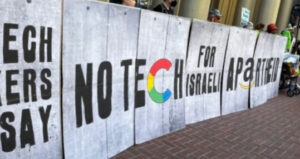
Global technology companies sustain structures of oppression in Palestine through million-dollar contracts with Israel. Meta (USA), Google (USA), Microsoft (USA), Amazon (USA), and NSO Group (Israel) stand out for financing, facilitating infrastructure, data, analysis software, or cloud services to enable the location, selection, and tracking of individuals. This makes these corporations key direct actors in state violence, as they facilitate systematic human rights violations.
Meta promotes asymmetry in content moderation: between 2021 and 2023, it removed 90% of pro-Palestinian posts on Instagram, while allowing the spread of hate speech in favour of Israeli genocide. This censorship is in line with Israel’s strategy of silencing testimonies about war crimes in Gaza. It was also accused of sharing data with Israeli authorities, which contributed to the digital persecution and location of activists.
Google, together with Amazon, through contracts such as Project Nimbus (£1.2 billion since 2021), provides artificial intelligence to the Israeli army so that it can map specific attacks in Gaza. Independent investigations (The Intercept) show that location data from Google Photos was used to select bombing targets in 2023, turning users into unwitting accomplices.
As for Microsoft, the American multinational has contracts with the Israeli government and army for digital infrastructure, data storage and software. In addition, various investigations suggest that its services are being used by Israeli security agencies to manage databases and track people in general, and activists in particular.
The NSO Group plays a key role in the repression process. Its Pegasus software has been spying on journalists and activists defending human rights in Palestine since 2016. In addition, there are dozens of documented cases of espionage against people who are part of social response structures in different states, as the NSO Group works centrally to spy on and dismantle solidarity networks.
Collectively, these corporations act not only as neutral technology providers but also as direct economic beneficiaries of the Palestinian genocide, reaping extraordinary profits from the war, the occupation, and mass surveillance. Every contract, every cloud service, every data analytics system translates into increasing revenue, market expansion, and validation of their technologies under real-world wartime conditions, which are then exported globally to other states as “security solutions.” Thus, under euphemisms like “digital security” or “technological development,” Palestinian suffering becomes both a laboratory and a business, revealing that digital apartheid is not a side effect of technological capitalism but one of its most brutal and profitable expressions.