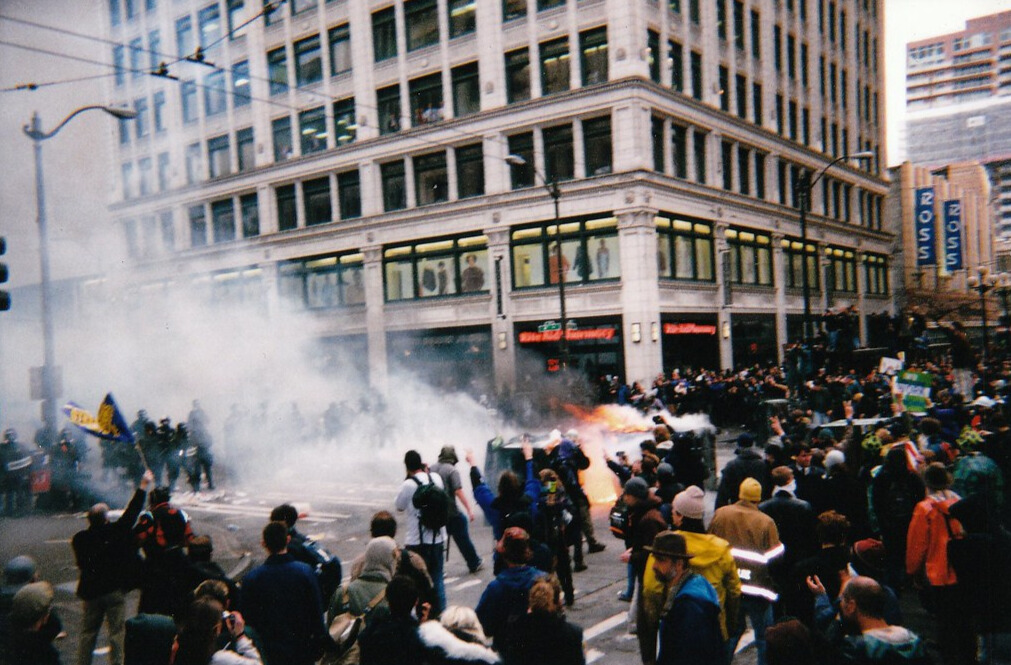
The Battle of Seattle, which took place between November 30 and December 3, 1999, during the World Trade Organization (WTO) meeting, marked a turning point in the struggle against global capitalism. The mobilization brought together more than 50,000 activists and militants from unions, environmental movements, student groups, and anarchist organizations in an unprecedented convergence that paralyzed the city. The objective was clear: to dismantle the myth of neoliberal inevitability through creative direct action.
The origin lies in the accumulation of three decades of structural adjustment policies imposed by the IMF and the World Bank. Between 1970 and 1990, these institutions privatized public services in 127 impoverished countries, dramatically increasing social inequality in all of them. Seattle became the epicenter of global outrage, articulated by networks like the Direct Action Network (DAN), which combined peaceful resistance with urban disobedience.
The strategy was based on tactical blockades: organized groups forming human chains obstructed all access to the Convention Center where the negotiations were being held. Techniques such as lock-ons (anchoring themselves to structures with pipes or chains) and creative distractions were used, while unions called for supportive strikes. The success lay in tactical diversity: from demonstrations to barricades, from walling off buildings to sabotage, all actions were coordinated through horizontal assembly processes prepared months in advance, lacking visible leadership.
The consequences were immediate: the WTO summit was suspended for the first time in history, and 28 trade liberalization agreements were canceled. Beyond the concrete results, Seattle demonstrated that organized citizens could challenge and confront transnational powers. The police crackdown, with over 600 people arrested and the use of rubber bullets, tear gas, and the continued beating of protesters with batons, exposed state brutality in defense of corporations, while announcing the new era that was about to begin in the West to defend the status quo.
The most profound legacy was the normalization of economic sabotage as an everyday tool of resistance. The tactics tested in Seattle were replicated globally (mass boycotts like the one against Nike in the 2000s for labor exploitation; creative occupations of bank headquarters during the 2008 crisis in various countries; or power outages against private electricity companies in Chile in 2019).
Today, Seattle remains a benchmark for organizations worldwide, as it marked a turning point in the repertoire of protest, demonstrating the enormous effectiveness that arises from combining diverse tactics: massive marches, acts of civil disobedience, cross-sectoral alliances, and alternative media (Indymedia was born there in 1999). The Battle of Seattle redefined the legitimacy of protest: the demands were no longer for reforms, but for the abolition of the system itself.