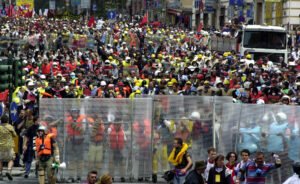
Between 19 and 22 July 2001, the Italian city of Genoa became the epicentre of the anti-globalization struggle. The meeting of G8 (Group of Eight) leaders triggered an unprecedented civic response, convened by the Genoa Social Forum, a platform that brought together around 800 organizations of different kinds. Estimates speak of between 200,000 and 300,000 people arriving from across Europe to take part in the counter-summit, at a time when the movement was at the height of its momentum.
The security apparatus designed by Silvio Berlusconi’s government was extreme. The city was virtually sealed off through the creation of the so-called “zona rossa” (“red zone”), a heavily guarded area enclosed with concrete barriers and accessible only to heads of state and government. Nearly 20,000 police officers and military personnel were deployed in the streets, and missile batteries were even positioned at the airport. This militarization, combined with a climate of prior tension fuelled by the media, foreshadowed an extremely harsh confrontation.
The days of protest were marked by a diversity of strategies. While hundreds of thousands took part in peaceful marches and acts of civil disobedience — such as the demonstration on Friday the 20th that attempted to surround the red zone — the “black bloc” and other groups following the same line of direct action carried out attacks against symbols of capitalism and clashed with law enforcement in various parts of the city. However, what truly shocked public opinion was the disproportionate response of the State. That same Friday, the young activist Carlo Giuliani, aged 23, was shot dead by a carabiniere and subsequently run over by a police vehicle, becoming the first martyr of the movement.
The repression did not end with his death; from that point on began what has been described as the most serious violation of human rights in a Western state since the Second World War. On the night of 21 to 22 July, police violently stormed the Díaz-Pertini school, where activists and journalists were sleeping, leaving 62 people injured. In the following days, hundreds of detainees were transferred to the Bolzaneto barracks, where they were subjected to systematic beatings and humiliation. Years later, the European Court of Human Rights condemned the Italian State, classifying the events at the Díaz school as “torture” and acknowledging the abuses committed in Bolzaneto. These rulings confirmed that the violence was not an isolated incident, but rather a premeditated strategy to criminalize the anti-globalization movement and send a warning to future mobilizations. At the same time, Genoa 2001 left an unquestionable legacy, as it turned sabotage into an everyday tactic: from boycotts of power companies to the occupation of bank headquarters.