The Chilean song that emerged before Pinochet’s 1973 coup and spread from the Seattle Battle to the Arab Spring
In June 1973, in Chile, the political situation was unsustainable. Marches, pot-banging protests, and strikes foreshadowed a dramatic outcome. In this context, composer Sergio Ortega gathered with the band Quilapayún to fulfill a commission from the Central Committee of the Communist Party: to create songs that supported Salvador Allende’s Popular Unity government. Between a curanto in the garden and Brahms’ chords, “El pueblo unido jamás será vencido” was born, a march whose percussive chorus became a collective cry.
The authorship of the piece is shared. The music was composed by Sergio Ortega Alvarado, pianist and composer at the National Conservatory, also author of the anthem “Venceremos.” The lyrics were created in collaboration with Quilapayún, a folk band sympathetic to Allende. Ortega recounted that the idea came from hearing a young man shout the phrase in the street, a slogan attributed to Colombian leader Jorge Eliécer Gaitán and adopted by communist youth across the Southern Cone. The first public performance was on June 12, 1973, during a march of Allende-supporting women in front of La Moneda Palace. (es.wikipedia.org)
On September 11, 1973, during the bombings in Santiago, the song acquired a tragic significance. Radio Magallanes, the Communist Party’s station, broadcast Allende’s farewell speech for the last time, and the chords of “El pueblo unido…” were heard. The military coup led by Augusto Pinochet started a 17-year dictatorship. Quilapayún and Inti‑Illimani members had to go into exile in France and Italy, turning their music into a voice of resistance. (es.wikipedia.org)
From Europe, the song spread rapidly. In 1974 it circulated at the X World Festival of Democratic Youth in East Berlin and was adapted in Portugal after the Carnation Revolution as “Portugal Ressuscitado.” The American pianist Frederic Rzewski composed in 1975 “The People United Will Never Be Defeated!”, 36 piano variations integrated into the contemporary music canon.
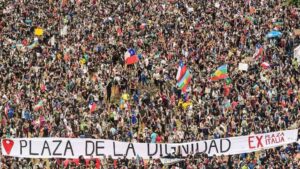
The anthem crossed borders and ideologies: it was sung at demonstrations supporting human rights and diversity. During the LGBT movement in Latin America, the 15M in Spain (2011), and the anti-globalization movement (Seattle 1999), its slogan served as a symbol of unity against social and political injustices. During the 2019‑2020 Latin American protests, in countries like Chile, Honduras, and Bolivia, the phrase was once again heard as a collective symbol of resistance. (justapedia.org)
Eduardo Carrasco, founder of Quilapayún, summarized: “It is a song that became a global anthem because people seek what they have in common and affirm it with strength“.