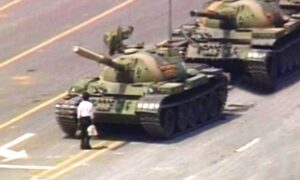
On June 1989, one day after the violent military crackdown on the Tiananmen Square protests, an anonymous man stood in front of a column of tanks on Chang’an Avenue in Beijing. The scene was photographed by several international photojournalists and became one of the most recognizable images of the 20th century. The photograph of “Tank Man” came to symbolize nonviolent direct action and civil resistance against military force.
The protests had begun weeks earlier with the participation of students, workers, and urban residents demanding democratic reforms, freedom of expression, and measures against corruption. The Chinese government had declared martial law in May and ordered the People’s Liberation Army into the capital following an escalating crackdown. On the night of June 3 to 4, armed troops moved against the civilian population.
It was in this context that the man in the photograph, known as the “Tank Man”, appeared. He wore ordinary clothes and carried two shopping bags. For several minutes, he blocked the advance of the armored vehicles and even climbed onto the first tank to speak with its crew. His identity has never been officially confirmed.
The image distributed by the international press became a global symbol of peaceful resistance, democratic protests, and civil resistance movements. More than three decades later, the photograph remains associated with the defense of civil rights and the ability of individual civic action to challenge state power.