The strike is a pressure tool of the working class as old as labour exploitation itself. The collective and temporary interruption of productive activity decided by workers in order to demand better working conditions or to protest against the company is a mechanism already normalised in the collective social imagination. The history of the strike is a chronicle of the working class’s struggle for its dignity, for its rights, and for a fairer society.
The first documented strike in history took place around 1152 BCE in Ancient Egypt, during the reign of Ramses III. The artisans of Deir el-Medina, who built the royal tombs, stopped working because they had not received their wages, which were paid in food. Their protest was successful, and they managed to collect what they were owed. In ancient Greece, protests by artisans and sailors over wage issues were recorded, although they were not organised like modern strikes. In ancient Rome, there occurred an event that was not exactly a labour strike, but it was a very effective form of collective pressure: the secessio plebis (“withdrawal of the plebs”), which from the 5th century BCE onwards made the plebs abandon the city or stop fulfilling their obligations in order to pressure the patrician class and achieve political and social rights.
In the Middle Ages, society was organised around the feudal system, so most of the peasantry depended on a feudal lord and had little capacity to organise strikes, although peasant revolts were numerous, almost always motivated by excessive taxes, feudal burdens, or famine. However, in the cities, craftspeople, who were grouped into guilds, occasionally carried out stoppages or protests when there were conflicts over wages, taxes, or working conditions, although these tended to be limited and were normally resolved within the guild itself.
With the arrival of the Industrial Revolution (18th–19th centuries), the working class was subjected to extreme conditions (working days of more than 12 hours, miserable wages, child labour…). Faced with this situation, spontaneous protests appeared, such as the destruction of machinery by Luddites, but in a short time the working class understood that the strike was a much more effective tool. Despite the development of a legal framework that expressly prohibited workers’ organisations, which were considered a criminal offence, mutual aid workers’ associations emerged and articulated the first sectoral strikes.
In the second half of the 19th century, anarchism and socialism would give demands a revolutionary character. The First International (1864) would promote worldwide workers’ unity, hosting within it two opposing positions: Marxism favoured organising into a party to conquer the State, while anarchism favoured an immediate revolution against all state institutions.
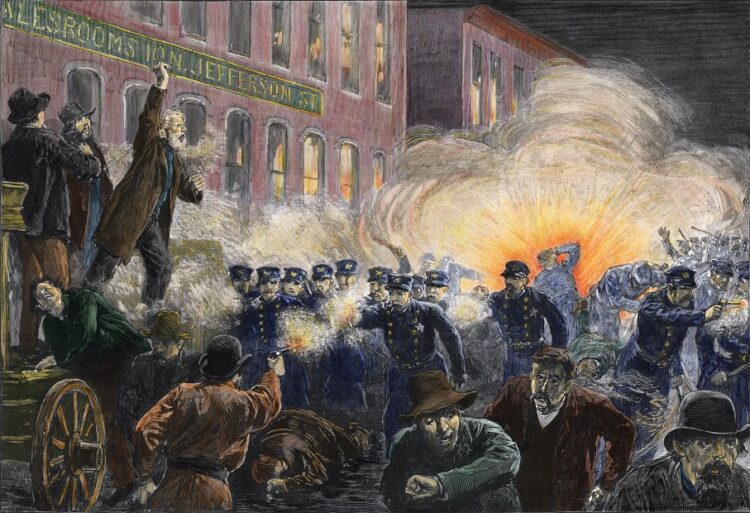
On 1 May 1886, a series of protests for the eight-hour day began, reaching their peak in the so-called Haymarket affair, which triggered strong police repression and ended with several leaders executed by the State. These would become known as the “Chicago Martyrs”, and the Haymarket affair would be the event used in 1889 by the Second International to declare that date as the annual day of workers’ struggle.
The 20th century began with massive strikes for the eight‑hour day, such as the 1919 strike in Winnipeg (Canada). General strikes paralysed entire cities, such as the 1926 strike in the United Kingdom. During the Great Depression, labour movements gained strength, but they faced employers like Ford, who hired thugs and spies while carrying out summary dismissals, and these conflicts eventually led to brutal repression, such as the Ludlow Massacre (1914, USA) or the Ponce Massacre (1937, Puerto Rico). After World War II, strikes contributed to the expansion of the welfare state: paid holidays, unemployment insurance, and pensions.
In the 1960s–70s, strikes shifted towards political and social demands, beyond strictly labour issues. The French May of 1968 exemplifies this period, with general strikes that mixed students and workers, and questioned capitalism, authoritarianism, and consumer society. With globalisation and the processes of deindustrialisation in the West from the end of the 20th century onwards, traditional strikes have continued to develop, but new forms of strike have also emerged (consumer strikes, feminist strikes, climate strikes, general strikes…).