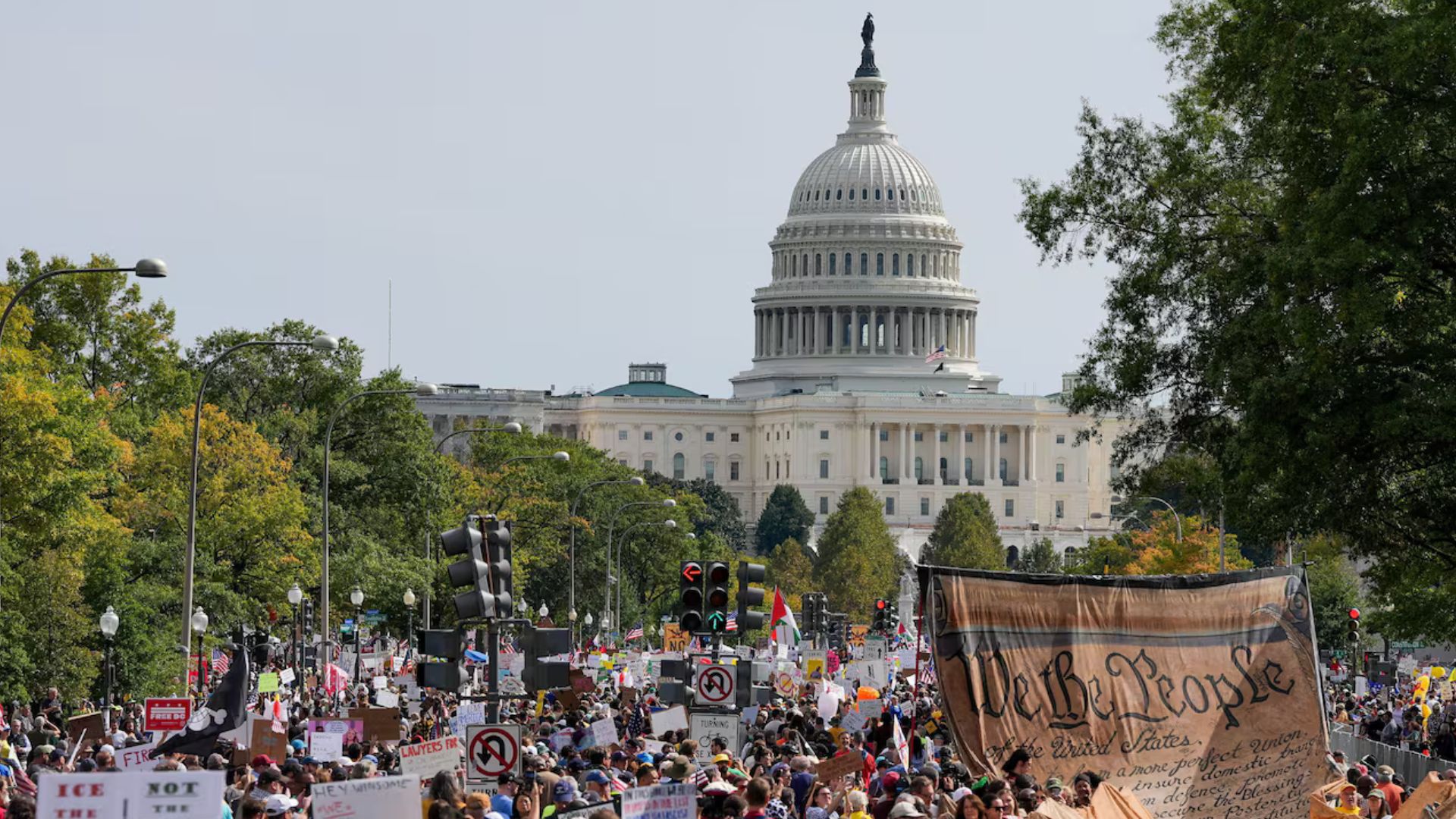
Hours before the start of the midterm elections on 3 November, US society is going through a moment of maximum tension. President Donald Trump, who returned to the White House after winning the 2024 elections with the promise of a new era of prosperity and bonanza for the United States, now faces a scenario in which his approval ratings are collapsing and his own party is beginning to show cracks. What was meant to be a referendum on his presidential management may turn into a serious problem for the tycoon, as he may lose control of a Congress that allowed him to govern with broad freedom over the past two years.
The situation in the House of Representatives is especially complicated for the Republicans. With 219 seats against the Democrats’ 214 and two vacancies, the conservative majority is as narrow as possible. The national average of voting intention for Congress puts the Democrats with an advantage ranging between 6 and 10 points in October. The most revealing figure is the presidential approval rating: 32% according to CNN/SSRS, the lowest level of his two terms, with disapproval reaching 68% on economic management. Emotional polarisation and the consideration of the elections from a national point of view (and not from the local point of view, that of his/her governor) turn these elections into an indirect plebiscite on Trump and, therefore, into an anticipation of the presidential race to be fought in 2028.
The Senate offers a more uncertain but equally threatening panorama for Trumpism. Republicans hold a majority of 53 seats against the Democrats’ 47, and 35 posts are up for renewal this year. Democrats need to gain four net seats to reach the 51 that would guarantee them control, since a 50-50 tie would give the casting vote to Vice-President JD Vance. The key states are concentrated in Michigan, Maine, Ohio, Iowa, Kansas, Alaska and Texas, with particular attention to the candidacies of Abdul El-Sayed in Michigan and James Talarico in Texas, who could make history in a Democratic Party seeking a generational relay.
The midterm campaign was characterised by a context of growing international tension. On 21 October, Trump declared that in Iran “one way or another, something very soon is going to happen”. The US army has been preparing for months to be able to launch a large-scale operation with targets including energy infrastructure, military bases and nuclear facilities. The war, which began in February this 2026, ended up becoming an economic (and emotional) burden for the US government, as voters directly perceive its effects on the cost of living. In addition, Trump and Rubio also put on the table the possibility of carrying out military action against Cuba, as they need to obtain a victory after the failure in the Persian Gulf and the country’s poor financial situation that would allow them to recover some of their damaged popularity.
The wear and tear is also reflected in Trump’s relationship with his own base. Approval among Republicans fell from 88% to 74% in just one year, and only 44% of conservative sympathisers approve of his management of the cost of living. Meanwhile, the president has intensified a discourse centred on immigration and identity which, together with his promise of a “dividend” of 5,000 dollars conditional on a Republican victory (a proposal that lacks legal basis without Congressional approval and was criticised even by legislators from his own party), shape a climate of polarisation that analysts consider decisive for the mobilisation of both electorates.
The result that emerges tomorrow, 3 November, will define not only the balance of power in Washington but will also orient the global geopolitical board. In addition, the decision at the polls will also serve to limit or maintain Trump’s capacity to legislate during the two years remaining in his term. The recovery of the House by the Democratic Party will make it possible to block the presidential agenda, promote parliamentary investigations and condition the federal budget. If the Democrats were also to conquer the Senate, the president would be forced to govern by decree, and would also have to face a much more aggressive and limiting institutional opposition. The unknown hovering over the electoral appointment is whether the economic discontent reflected in the polls will translate into a Democratic wave with enough strength to change the country’s political course.
Sources
-
Diario Público (2026). Cuándo son las elecciones de Estados Unidos 2026: fecha de las ‘midterms’ y qué se vota. https://www.publico.es/internacional/eeuu/son-elecciones-estados-unidos-2026-fecha-midterms-vota.html
RaiNews (2026). Midterm 2026: democratici avanti a 8 giorni dal voto, vantaggio più netto alla Camera che al Senato. https://www.rainews.it/maratona/2026/10/midterm-usa-2026-democratici-repubblicani-risultati-voto-donald-trump-c28c044e-836e-49ee-987a-240d4ed4be95.html
The Hill (2026). Democrats hold 10-point advantage ahead of midterms: Survey. https://thehill.com/homenews/campaign/6162170-democrats-hold-poll-advantage-midterms/
KBS News (2026). “트럼프 지지율 32%, CNN 조사 최저치…중간선거 민주당 지지 49%”. https://newsws.kbs.co.kr/news/pc/view/view.do?ncd=8692168
Yonhap News (2026). “美중간선거 민주당 후보 지지 49%…공화당에 10%p 앞서”. https://www.yna.co.kr/view/AKR20261022012500071
Rti 中央廣播電臺 (2026). CNN:美軍備妥大規模攻伊朗計畫 川普可能期中選舉後下令. https://www.rti.org.tw/news?uid=3&pid=239883
John Zogby Strategies (2026). Democratic Party Leads Republican Party 48% to 42% in Congressional Generic Ballot as Race Heats Up. https://johnzogbystrategies.com/democratic-party-leads-republican-party-48-to-42-in-congressional-generic-ballot-as-race-heats-up/
La Opinión (2026). Demócratas se acercan al control del Congreso con el 77% de probabilidad de ganar la Cámara Baja. https://laopinion.com/2026/10/15/democratas-se-acercan-al-control-del-congreso-con-el-77-de-probabilidad-de-ganar-la-camara-baja/
Descifrando la Guerra (2026). ¿Han muerto las midterms en Estados Unidos? https://www.descifrandolaguerra.es/han-muerto-midterms-estados-unidos/
Diario Público (2026). Las batallas electorales decisivas que podrían dejar a Trump sin el control del Congreso. https://www.publico.es/internacional/eeuu/batallas-electorales-decisivas-podrian-dejar-trump-control-congreso.html
The Hill (2026). Trump pledges $5K checks if Republicans do well in the midterms. Can he legally do that? https://thehill.com/homenews/administration/6085556-trump-midterm-dividend-legal-questions/
elDiario.es (2026). Trump usa las protestas en Francia azuzar el racismo: “Tienen que ver con la migración, París será pronto una ciudad musulmana”. https://www.eldiario.es/internacional/trump-protestas-francia-azuzar-racismo-ver-migracion-paris-sera-pronto-ciudad-musulmana_1_13598639.html