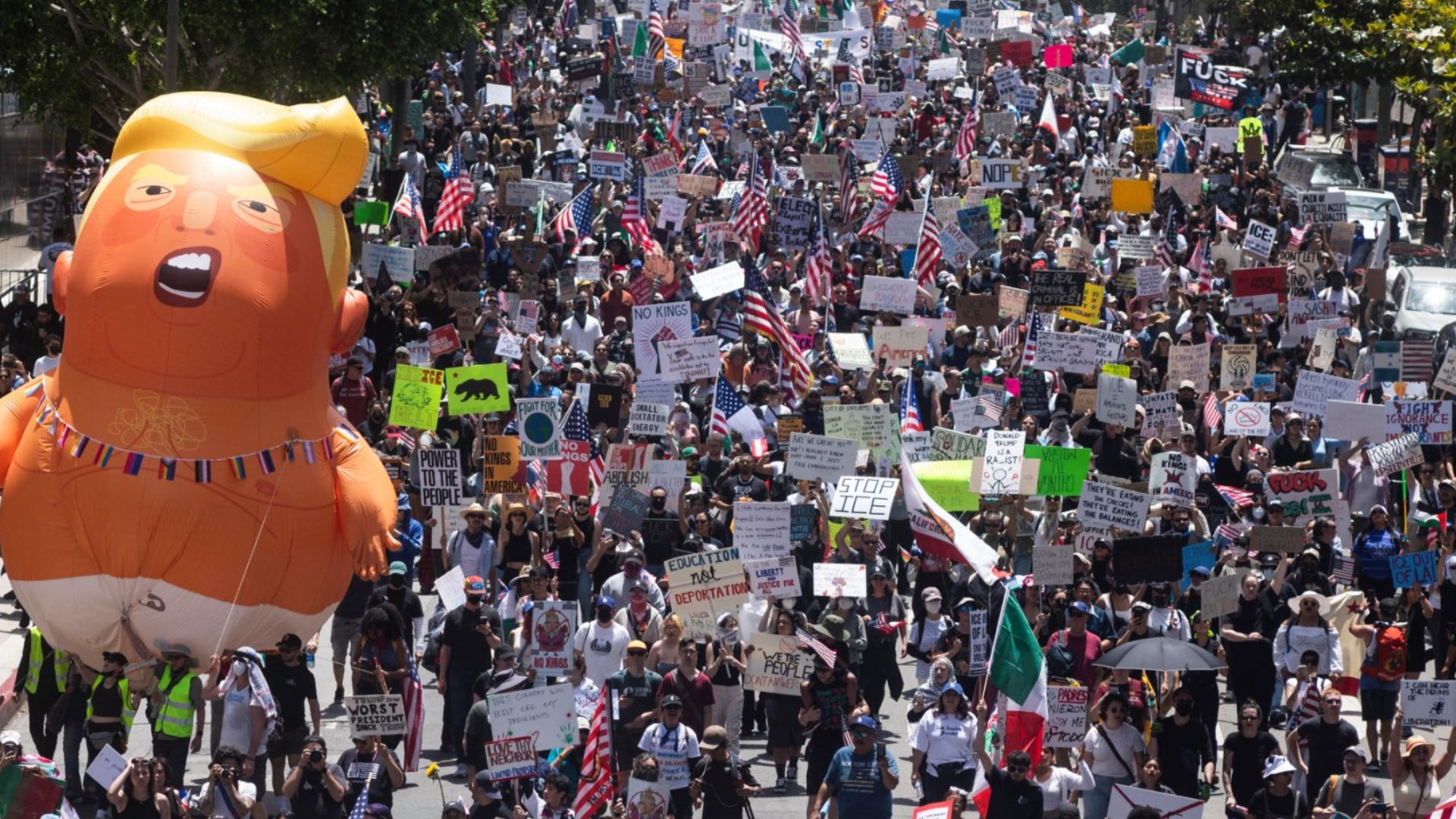
Pending definitive verification, the results of the midterm elections in the United States represent a crushing and unmitigated defeat for Donald Trump and his reactionary agenda. The Democratic conquest of the House of Representatives and the Senate is not a simple institutional adjustment, but the snapshot of a massive popular response against a Government clearly marked by brutality, both domestic and in foreign policy, corruption and an anti-democratic temperament with philo-fascist overtones. While the result should not be assumed to be a victory of the Democratic elites, but rather a process of popular grassroots change to halt authoritarianism that aspires to rebuild the foundations of a fairer society, both within and beyond US borders.
The first consequence of Trump’s defeat translates into a victory of a defensive nature, since from January onwards the legislative agenda of the far right will systematically die in Congress. Furthermore, the new Democratic majority will have the power to subpoena and investigate. It remains to be seen what the Democratic strategy will be, but they now have full capacity to initiate impeachment proceedings in the House of Representatives, although lacking a two-thirds majority in the Senate they are not guaranteed to bring that process to a successful conclusion. The context and previous statements by various figures in the party allow us to foresee a more cautious position regarding the possibility of pursuing a third immediate impeachment (in order not to repeat the mistakes of 2019 and 2020), orienting their strategy towards the institutional asphyxiation of Trumpism through an overwhelming judicial and parliamentary siege. It seems clear that the Democratic party will seek to dismantle the Trump family’s corruption network and, in particular, will seek to hold to account and wear down various key figures in the Trumpist government such as the Secretary of Defense, Pete Hegseth, over the disastrous management of the war.
One of the most critical points of the domestic agenda is immigration policy. The Trump administration was pressuring ICE (Immigration and Customs Enforcement) to carry out up to 3,000 arrests a day, in a spiral of violence that left several people dead in various cities and that translated into a climate of terror throughout the entire territory of the United States. The strong popular mobilisation and social response clearly contributed to the Republican defeat, sending a clear signal that the racist policy of persecution against the working classes carries a high political cost. It will be a practically certain position that a Congress with a clear Democratic majority will limit funding and demand accountability for ICE’s paramilitary operations, halting the xenophobic and racist machinery of mass deportation.
Another of the points that faces strong opposition is the political persecution of opponents by the Trump administration. It seems that the McCarthyist-style policy initiated by Trumpism, seeking to persecute positions related to left-wing ideologies and dissidence, will come to an end. Last July, 66 countries were present in Washington to participate in an international summit that sought to combat “far-left terrorism” and the activity of networks such as “Antifa”. This summit marked the beginning of a new way of understanding the fight against dissidence, since left-wing organisations became one of the three types of terrorism for the United States (alongside jihadism and drug trafficking), and US authorities arrogated to themselves the capacity to intervene and detain anyone in third countries. This political line appears to have its days numbered after Democrats from different currents within the party showed their firm opposition and harshly criticised both the event itself and the violation of rights and freedoms that it entailed.
As regards the international plane, the consequences are similar, since Trump’s capacity for action in foreign policy, based on threat and war, is severely limited. The war against Iran was one of the main reasons for the Republican electoral disaster, both for the cost in lives and for the oil inflation it caused. As had happened decades earlier with Vietnam, the Democratic majority will probably orient its line of action towards cutting war funding. This would translate into the opening of a process of real de-escalation and a return to diplomacy, although there is a strong possibility that Trump will resort to accelerating a military adventure in order to condition the management of the war with the Persian country. As a result, the Gulf countries appear to breathe a sigh of relief at the prospect that the conflict in the region can be halted or de-escalated. To a lesser extent there will also be a change of scenario for the situation with Cuba, since the escalation of the strategy of asphyxiation will be partly blocked. The Democratic party, while sensitive to the interests of certain sectors opposed to the Cuban revolution in Florida, also has a social base clearly positioned against the cruel and genocidal policies established by the Trumpist government, so it is highly likely that it will limit Trump’s capacity to escalate militarily or impose harsher sanctions. Nevertheless, it must be borne in mind that Washington will not lift the blockade unilaterally, and the only thing that can indeed occur is a stage of “low-intensity negotiation” where Havana will continue to be the victim of a genocidal foreign policy on the part of the United States. With reference to China, it appears that, with the Democratic party’s dominance of both chambers, the direct impact on relations and dynamics with the Asian country will be limited. Policy towards Beijing is a state consensus between the two parties in the House of Representatives. Although Trump might seek rapid agreements in order to boast of “diplomatic successes”, this appears to be a dead end, since any concession that either party makes to the Asian country will provoke “noise” and “political ammunition” for the opposing bench.
On the other hand, the results obtained by Trump in this 3 November Midterms have serious consequences for his allies. Europe, which if anything stands out from the end of the Second World War, but above all since the arrival of Trumpism to power, is for total submission and the assumption of its role as a colony of the United States, finds itself at a crossroads. European countries and, especially, EU bodies are terrified, since they fear that a humiliated and “wounded” Trump will unleash his fury on NATO, demanding greater defence spending to satisfy his base. As for Israel, Netanyahu’s Government (already in a situation of weakening after the electoral result of last 27 October) is left in an uncomfortable position, since it loses its unconditional ally in the White House, while the Democratic party’s bicameral control, completely aligned with Israel’s theses for decades but with a clear rejection in its social base of the Palestinian genocide in recent times, may produce a blockage of funding and participation in Israeli military operations and demand greater respect for international law.
Trump’s crushing defeat is not an isolated event, but one more sign of the setback that the “wave” of the global far right has been suffering in recent years. The model of nationalism, xenophobia and anti-democratic government that Trumpism represents is experiencing a process of unprecedented social response that is beginning to translate into electoral reverses in several countries. Brazilian President Lula da Silva defeated Jair Bolsonaro in the runoff, the Student List in Serbia defeated Trump’s ally Aleksandar Vučić, while liberals and centre-left parties in Canada and Australia managed to halt Trump-style populist offensives. Trump’s own defeat, as the defeat of the most emblematic figure of this wave, has a symbolic significance that transcends the borders of the United States, and indicates that international far-right positions and networks are losing strength and political space. It should be borne in mind that the different forces and organisations that drive the ideological agenda of the far right are already working towards the “post-Trump era”, attempting to institutionalise their influence and guarantee the survival of illiberalism beyond the political life of specific leaders.
Progressive and democratic forces must take advantage of this situation to accelerate organisation and mobilisation, turning the advance of electoral results into an impulse for structural change. The Brazilian situation offers the most direct case for understanding the domino effect of Trump’s defeat. Lula’s victory creates a leadership vacuum in the Brazilian far right (Jair Bolsonaro is in prison and his son Flavio went to the United States after the elections) while the left-wing coalition gains political space to advance its social agenda. This result, together with Trump’s defeat and the corresponding future reduction in Washington’s capacity to impose soft coups or unilateral sanctions, means that in Latin America progressive forces and governments feel strengthened to address a new stage in which to reconquer lost space. For Argentina this means that it loses its most reliable ideological ally in Washington and that, therefore, the political backing and extraordinary financial assistance of Trumpism will change its reality, which will be much harder to obtain with a Congress controlled by the Democrats and which, at the same time, will deepen Milei’s international isolation.
The focus now shifts to the Spanish elections of 29 November, where Trump’s defeat reshapes the electoral scenario as it directly weakens the position of Vox, which publicly embraced Trumpism and presented it as an international model, and indirectly weakens the PP, which has an Atlanticist position absolutely subordinated to Washington and to the line set by the Republican party. A new defeat of Trumpism on the Spanish stage, which until the great social mobilisation for housing had made a conservative victory with a coalition government formed by the right and the far right almost certain, would mean the definitive confirmation of a new global trend moving away from far-right positions. However, defeat does not mean that Trumpism will withdraw peacefully (as it already demonstrated in the assault on the Capitol in 2021), but rather that it will seek to accelerate processes and increase tension and social polarisation in order to erode democracy. After a decade marked by resistance, the task of the left now is to press and multiply its response in order to advance in freedoms and rights, with the goal set on the definitive elimination of the public space of far-right voices, forces and organisations. It is time to reconquer common sense. It is time for anti-fascism to once again occupy every inch of society.