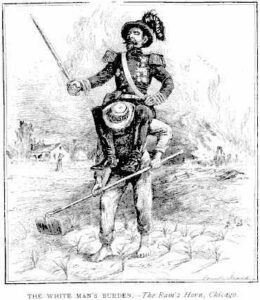
The legacy of imperialism shapes the present. Understanding its evolution is a necessary tool for analyzing the geopolitical and economic tensions of the 21st century. A chronological journey reveals how dynamics of domination adapted to the times. The Berlin Conference (1884-1885) was one of the major events of contemporary history, marking the division of the globe into spheres of influence and the partition of the African continent. Under the justification of social Darwinism and civilizing paternalism, the United Kingdom, France, Germany, Italy, Portugal, the Spanish State and King Leopold II of Belgium obtained territories in Africa, while no African representation was present at the negotiations. This process constituted the last and most intense phase of colonization, consolidating European, Japanese and US dominance over most of the world. The imperialist expansion of the 19th century was not only economic and political, but also cultural, generating a new nationalist consciousness supported by pseudoscientific currents. The exploitation of natural resources and the introduction of artificial borders, alien to ethnic realities, laid the foundations for later conflicts. To explain this phenomenon, theoretical analyses emerged that place economic exploitation at the center of imperialist dynamics.
The First World War represented the first major fracture of the imperial system, by exposing the inter-imperial rivalries that the system itself had generated. After the Second World War, the world political map underwent a profound transformation with the beginning of decolonization. Between 1945 and 1960, three dozen new states in Asia and Africa achieved autonomy or full independence from their European colonial rulers. A fundamental milestone was the approval of United Nations General Assembly Resolution 1514 (XV), on 14 December 1960. This resolution, considered the Magna Carta of decolonization, proclaimed the right of all peoples to self-determination and stated that lack of political, economic, social or educational preparation should never serve as a pretext to delay independence. Based on this Declaration, the aspirations of more than 50 peoples subjected to colonial rule became reality.
However, formal political independence did not mean the end of relations of domination. Neocolonialism then emerged, defined as a new form of colony based on the economic, political, cultural and ideological dependence of one country on another. Unlike traditional colonialism, the neocolonized country is not physically occupied by forces from the dominant country; there is official political independence, but other indirect methods are maintained to guarantee dependence (World Bank, IMF, WTO…). These mechanisms include support for local political elites and influence through international financial institutions.
Debt remains an overwhelming element for many countries in the Global South, which on average allocate 48% of their budget to debt and interest payments, an amount that exceeds investment in health, education and social development. According to an “Oxfam” report, 77% of global wealth is concentrated in the Global North, even though these countries represent only one fifth of the world’s population. The analysis of this historical evolution allows us to understand that imperialism is a reality that continues to shape international relations and generate inequality at the global level.
In the 21st century, imperialism has adopted new forms without losing its essence. The report “Estado del Poder 2025” by the “Transnational Institute” analyzes whether US imperialism is coming to an end and whether a Chinese empire is beginning. The rivalry between both powers manifests itself in competition for control of resources, markets and global networks. Domination is no longer exercised only over physical territories, but also in digital space and global supply chains, configuring a scenario of renewed spheres of influence.
Sources
-
Madueño Álvarez, Miguel. (2025). The Berlin Conference: From the Colonization of Africa to the Partition of the World (1870-1914). Ediciones Trea. https://dialnet.unirioja.es/servlet/libro?codigo=1005827
-
Smith, Bonnie G. (2000). Imperialism: A History in Documents. Oxford University Press. https://global.oup.com/ushe/product/imperialism-9780195108019
-
United Nations. (1960). Resolution 1514 (XV): Declaration on the Granting of Independence to Colonial Countries and Peoples. https://www.ohchr.org/es/instruments-mechanisms/instruments/declaration-granting-independence-colonial-countries-and-peoples
-
Oxfam. (2025). The Plunder Continues: Poverty and Extreme Inequality, the Legacy of Colonialism. https://www.sar.gob.hn/2025/03/oxfam-la-mayor-parte-de-la-riqueza-de-los-milmillonarios-es-fruto-del-saqueo-no-del-esfuerzo/
-
Transnational Institute. (2025). Geopolitics of Capitalism. State of Power 2025. https://www.tni.org/es/publicación/geopolitica-del-capitalismo
-
Said, Edward. Orientalism. (Cited in Semantic Scholar). https://www.semanticscholar.org/author/Said-den-Ursprüngen/122417056
-
Nkrumah, Kwame. (1965). Neo-Colonialism: The Last Stage of Imperialism. (Cited in The Encyclopedia of Empire). https://onlinelibrary.wiley.com/doi/10.1002/9781118455074.wbeoe087