The origin of the concept of non-violence can be traced back to the term Ahimsa: a word derived from Sanskrit, where hims means ‘desire to kill’ and a- is the prefix of negation. This concept, characteristic of the Jain and Buddhist religions, was used politically by Gandhi in his philosophy and his struggle for independence. Thus, non-violence can be defined as the desire to end violence, whether physical or structural, without resorting to further violence to do so. It can refer to a philosophy of respect for life or a theory of social action, or both at the same time.
As a theory of social action, we focus on the concept of active non-violence, a set of methods of political and social struggle in which weapons are not used. These methods of struggle are very broad and varied, and many of them were compiled by Gene Sharp in 1973. They can be grouped into three distinct categories:
1. Protest and persuasion
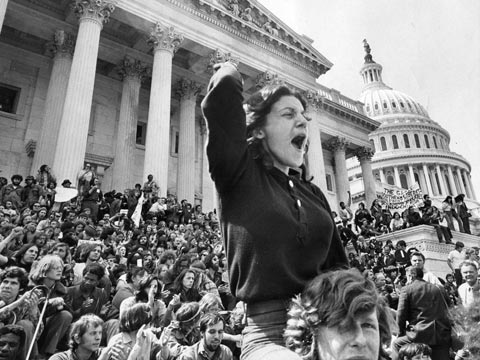
Here we find political statements in the form of speeches, manifestos, letters, petitions, posters, leaflets, protest lists… and public acts of protest such as performances, vigils, public assemblies, talks… Special mention should be made of marches or demonstrations, where large numbers of people are brought together to express political ideas by marching together from one place to another. One example is the anti-Iraq War demonstrations on 15 February 2003, which drew millions of people in over 600 cities around the world.
2. Non-cooperation
This may refer to methods of social non-cooperation, such as refusing to collaborate (e.g. Norwegian teachers refusing to teach the Nazi curriculum during the Second World War), to political non-cooperation, such as civil disobedience against illegitimate or unjust laws (e.g. the conscientious objection movement against compulsory military service), and economic non-cooperation such as boycotts (e.g. the boycott of Israeli products promoted by the BDS movement over the Palestinian genocide), or strikes (refusing to work).
3. Intervention
These may include methods of psychological intervention (such as hunger strikes), physical intervention (such as sit-ins, occupations or blockades – using the body as a barrier), social intervention (such as the use of alternative communication systems), economic intervention (such as the use of an alternative currency) or political intervention (such as exposing secret agents). Special mention should be made of ‘plowshares’ actions, in which weapons are openly dismantled and the participants accept conviction (e.g. actions by Palestine Action in the UK against Elbit Systems).
Sources
-
Ahimsa: Its theory and practice in Gandhism (Dr Ram Ponnu) Link: https://www.mkgandhi.org/articles/ahimsa-Its-theory-and-practice-in-Gandhism.php
-
Handbook for Nonviolent Campaigns (War Resisters’ International). Buy: https://13editora.org/es/projects/manual-para-campanas-noviolentas/
-
198 Methods of Nonviolent Action (Gene Sharp). Link: https://www.aeinstein.org/198-methods-of-nonviolent-action