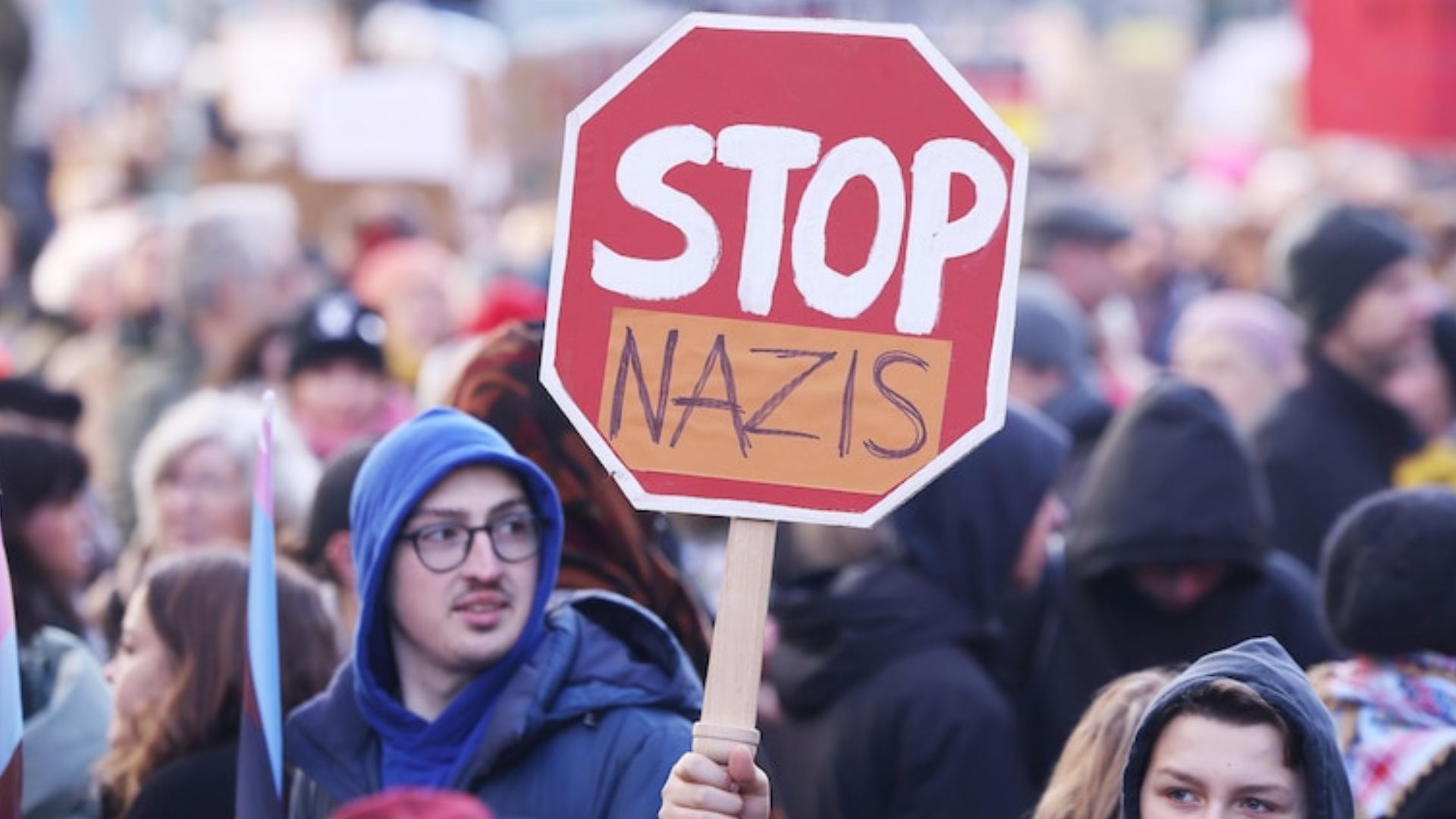
This text is part of the contents of the first book by ECOAR))) and will go on sale at the end of this year, 2026. Winning the Narrative! Manual for Combating the Far-Right Discourse.
Far-right is a word whose etymological origin is formed by the prefix “ultra” (from the Latin “ultra-“, meaning ‘beyond’, ‘extreme’) and the root “right” (from the Latin “-directa”, meaning ‘right’, ‘straight’). In the French National Constituent Assembly during the revolutionary process of 1789, the conservative deputies and defenders of the Ancien Régime sat on the right side of the National Assembly, while the deputies in favour of profound changes that would alter the structure of the Ancien Régime sat on the left. For this reason, the term “right” was used, by extension, to define conservative thought that understands society as based on hierarchy, authority, security, order, tradition and inequality; and, therefore, the “far-right” is etymologically defined as that ‘right taken to the extreme’. Thus, the term far-right tends to be a diffuse label that groups together a heterogeneous set of diverse and constantly changing political movements (Nazism, neo-Nazism, fascism, neo-fascism, post-fascism, paleoconservatism, Alt-right, Nouvelle Droite, Old Right, Q-Anon, neo-patriotism, eco-fascism, far-right accelerationism…). Although all these groups share a rejection of and hostility towards liberal democracy, they can be classified into two broad groups:
-
Extreme right. Encompasses movements and parties that seek to abolish the democratic system and replace it with an authoritarian regime. It rejects popular sovereignty, citizen equality and free elections, placing itself outside democratic legality. It frequently resorts to or justifies violence as a means of political action. Its historical references are fascism and National Socialism, which defended totalitarian states, centralised power and the elimination of political opposition.
-
Radical right. A political current that operates within representative democracy and regularly participates in elections, accepting that rulers must be elected by the people. However, it questions basic principles of liberal democracy, such as the rule of law, the protection of minorities, and political pluralism. Its ideology is based on three elements: nativism (priority of native people over foreigners), authoritarianism (defence of order and authority) and populism (opposition between the people and the elites).
To understand the complexity of this phenomenon, the German political scientist Klaus von Beyme distinguished in 1988 three waves of far-right since the Second World War, to which Cas Mudde added a fourth wave in 2021. This periodisation shows the transformation from the defeat of fascism in the Second World War to the present day.
-
1st wave (1945-1955). Survival of historical fascism. Made up of neo-fascist and neo-Nazi groups that tried to keep alive the ideas of the defeated regimes, namely Nazi Germany and fascist Italy. The few existing groups were openly neo-fascist and, therefore, marginal and with little electoral relevance. Their supporters were imprisoned, persecuted or forced to reinvent themselves through more moderate political options.
-
2nd wave (1955-1980). Adaptation to the democratic game in which they do not believe. Explicit fascist rhetoric is abandoned and they begin to participate in elections, although they remain minority formations. In this Cold War context, they settle in Western countries and focus on the fight against communism, an issue that helps them begin to leave their marginal situation. In the United States, the beginning of this wave coincides with McCarthyism, which promoted the persecution of left-wing ideas and people, while in Europe some of the most extreme groups were instrumentalised in Operation Gladio (a clandestine CIA and NATO network aimed at combating communist influence in Europe).
-
3rd wave (1980-2000). Rise of the populist radical right. In a period marked by the strong changes brought about by globalisation (deindustrialisation of the West, configuration of diverse societies in terms of nationalities and religions, as well as the rise of supranational projects such as the European Union), the radical right will rise, achieving significant electoral successes in several European countries through a discourse focused on rejection of immigration, national identity, insecurity, criticism of political elites, and defence of the primacy of national interest.
-
4th wave (2000-present). Disappearance of the perception of the far-right as a marginal or extreme force, so that its parties are integrated and normalised in political systems. Many parties come to form part of governments (United States, Hungary, Brazil, Israel, India…) or to decisively influence public policies (France, Germany, Spain, Portugal, Belgium, the Netherlands, Austria…). This rapid rise is explained by a double crisis: security (derived from the rise of jihadist terrorism since the 9/11 attacks in 2001) and economic (initiated with the fall of Lehman Brothers and the subsequent economic crisis of 2008). This double crisis was further reinforced by the refugee crisis of 2015. All of this will facilitate the spread of its discourse, which is based on the rhetorical criticism of globalisation, outright rejection of immigration, Euroscepticism and opposition to multiculturalism. During this period, it will multiply its strength by developing a strong communicative presence, both on social networks and in the media, thanks to strong funding obtained from large corporations and large fortunes.
Thus, the current far-right is a multifaceted phenomenon ranging from neo-fascist parties with parliamentary presence to liquid and transnational movements such as the Alt-right or QAnon. All of them, however, share a rejection of liberal democracy in its fundamental aspects, a deep ultranationalism, and an anti-establishment discourse.