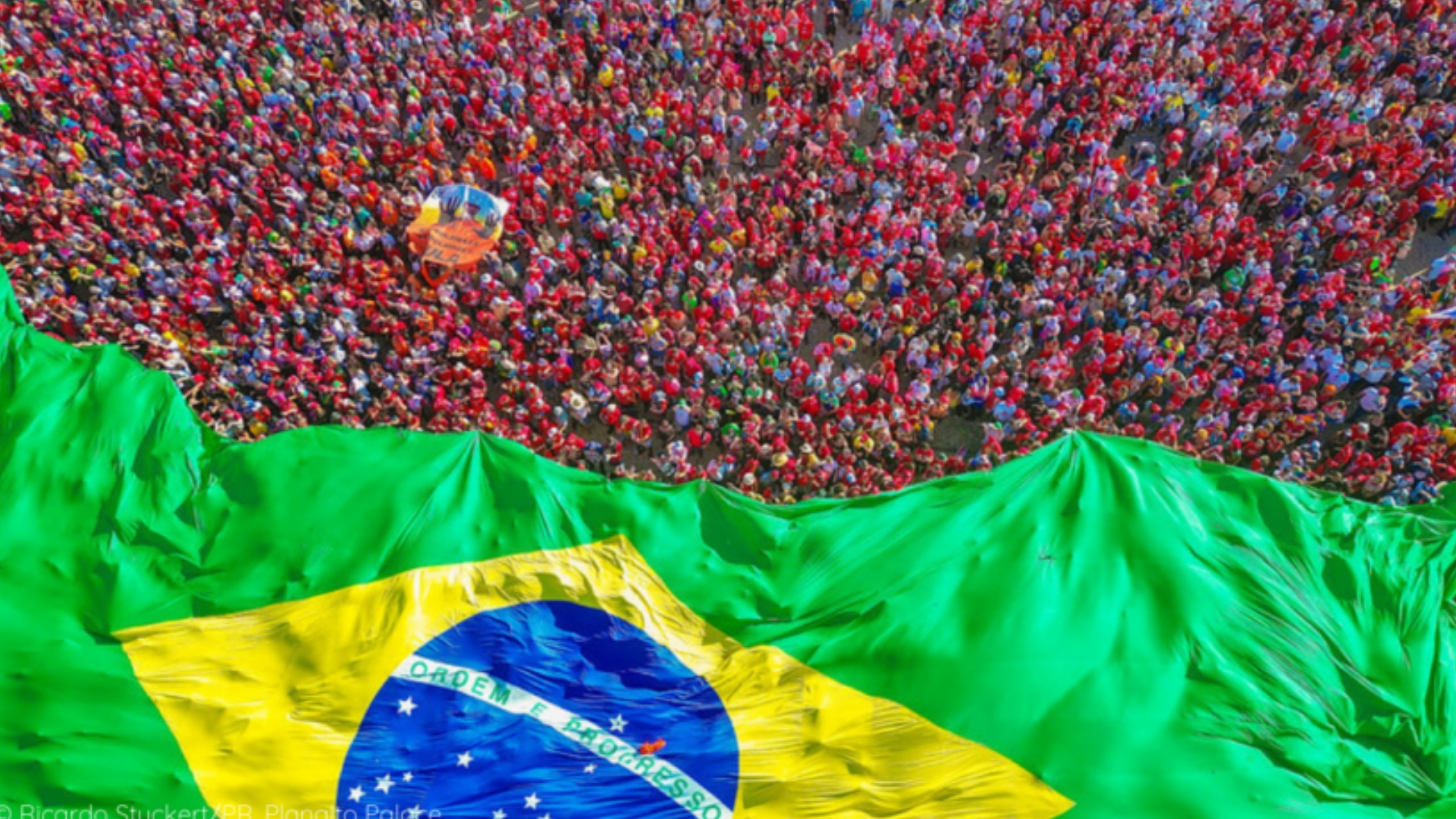
The recent electoral victory in Brazil, which demanded a strategic and communicative shift in the Workers’ Party (PT) around the figure of Lula da Silva, is a symptom of the new configuration of political struggle in the 21st century. The PT’s change in approach does not allow for a resounding statement on the global dimension, but it seems to be a turning point where left-wing structures are beginning to assume that in this context, where the rules of the democratic game are being sabotaged by reactionary actors, they must face a permanent hybrid war. In this context, it seems that contesting the digital ecosystem and developing a mixed mobilisation combining the street and the network are fundamental pillars to be able to confront the political contest with solvency.
The PT’s communication strategy in the second round of the Brazilian presidential elections had a name of its own: André Janones. The federal deputy transferred the logic of “digital guerrilla” warfare to the electoral campaign, transforming a traditional and analogue campaign into a machinery of mass and decentralised mobilisation through a central command via WhatsApp. After the defeat in the first round, Janones created the “Lula’s Army” channel, which brought together more than 10 million followers, and which was conceived not as a simple propaganda broadcaster, but as a command structure from which to coordinate concrete actions: setting trends, saturating the opposition’s posts and countering disinformation. Janones’s strategy was based on the thesis that the political dispute at the present moment was not programmatic but centred on the “monopoly of attention”. Thus, communication demanded vertical videos, alarming headlines, colloquial language and direct emotional appeal, rejecting elaborate discourses which, according to the deputy, were causing the left to lose out in the digital ecosystem. This, combined with street mobilisation and the continuity of the presence of “traditional and analogue” discourse through traditional channels, brought about a turning point in the campaign. Spontaneous militancy became the protagonist of the campaign and connected the message with everyday problems (cost of living, economy…) instead of focusing its discourse exclusively on Lula’s biography. This made it possible to multiply the message and to have the immediate capacity to adapt to almost any context, in addition to the identification and feeling of real protagonism of change among the participants.
It seems that the Brazilian case will be a turning point in the trend of recent decades where the right and, above all, the far right seek not only to win elections, but to delegitimise democracy itself. And in that context, the active complicity of the so-called “techno-oligarchs” is fundamental: the magnates of the large technology corporations who, with a clear political bias, influence governments and support Eurosceptic and denialist parties. Their participation in the democratic process is intrinsically undemocratic, since it subordinates popular sovereignty to their private interests and to the deregulation of their businesses.
Furthermore, it is important that the left does not fall into the false idea of understanding this form of struggle as something punctual to be used only in electoral processes. This type of battle combining digital and analogue communication, street and network and other planes, must be the regular and normalised procedure of any organisation in the socio-political sphere. In this same vein, it must be understood that the construction of a hybrid impact starts from the base of the capacity for influence, and this, today, materialises through control of algorithms. Digital platforms have ceased to be mere information channels to become infrastructures centred on capturing attention that define the agenda, people’s vision of reality and also the visibility of political actors. The algorithm is not neutral: it amplifies emotionally charged and hostile content. This creates bubbles of reaffirmation that prevent healthy democratic debate and distort the perception of the social majority, making minority noise appear as majority consensus.
For years the far right has known how to exploit this architecture to impose narratives, mobilise its bases and condition social and electoral processes. The rise to power of Trump and Netanyahu cannot be understood without two tools that transformed political struggle into a digital and opaque battlefield. Cambridge Analytica, with its mass extraction of Facebook data and its segmented advertising, provided Trump with an unprecedented psychological persuasion machinery in his 2016 campaign. For its part, Pegasus, the spyware of the Israeli company NSO Group, was used against activists and opponents.
Furthermore, US and Israeli interference in electoral processes is a documented reality. These two states wage a hybrid war (combining cyber operations, propaganda and disinformation) against their adversaries and against sovereignty and popular will themselves. A clear example is the case known as “Hondurasgate”, which exposed the plan by the United States and Israel, with the support of Honduran and Argentine sectors (among whom the former Honduran president Juan Orlando Hernández and the Argentine president Javier Milei stand out), to destabilise progressive governments in the region. According to leaked audio recordings, the aim was to create “digital journalism” cells to spread fake news against progressive governments, such as those of Mexico and Colombia, involving figures such as. Another example of US and Israeli interference is what happened in Ceuta in July 2026: taking advantage of the racist border necropolitics between the European Union and Morocco, they used human lives for political ends through social conditioning techniques via algorithms, causing the death of 142 people and giving rise to a serious humanitarian crisis that exposed the systematic violation of human rights at the southern border.
The left cannot ignore that democracy itself is under attack from a radical and reactionary right that uses the economic and communicative power of the techno-oligarchs, algorithmic manipulation and external interference to try to impose its will. The defence of democracy demands, today, not only institutional and street struggle, but also the construction of a political and communicational counter-offensive that employs a new repertoire and new forms of struggle proper to that hybrid war while reconnecting politics with the real needs of the social majority.