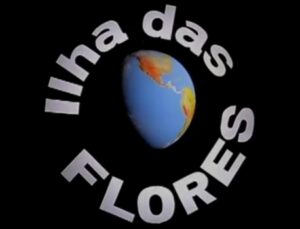
The birth, development and spread of large corporations, which carry in their DNA a contempt for human rights and the environment, constitute the engine driving current consumption. The essay/documentary short film ‘Ilha das Flores’ (1989), directed by Brazilian filmmaker Jorge Furtado, materializes this critique through the journey of a simple tomato to a landfill in Porto Alegre. In 13 minutes, the work turns the production, distribution and consumption chain into a stark metaphor for capitalism and the social inequalities it generates.
Thus, the film employs an almost scientific language and an off-screen narrator who explains with irony and monotony the functioning of, among other things, today’s economy.
It all begins in Mr. Suzuki’s vegetable garden, where the tomato grows and is harvested to be sold to a supermarket. It is there that Mrs. Anete buys some tomatoes along with pork. But she considers one of the tomatoes unsuitable for the dish, and it ends up in the trash, along with the rest of the kitchen waste.
That trash travels to ‘Ilha das Flores’, a real landfill located in Porto Alegre. At the landfill, they select organic waste that can still be used to feed the pigs; what they consider unfit for the pigs, they offer to women and girls.
The voice-over defines the human being as an organism with a highly developed brain and an opposable thumb, but concludes that, within the system, those without money are excluded from all preference, placing themselves in inferiority to other animals.
The production has won multiple awards and was chosen as one of the hundred most important short films of the century.
The historical context in which the film emerges is no coincidence. In 1989, Brazil was experiencing the first steps of redemocratization after the military dictatorship (1964‑1985), with a recent Constitution (1988) and the first direct presidential elections to be held that same year. Hyperinflation made access to basic goods difficult, and social inequality reached extremes. Furtado shot the film in 1988, when Porto Alegre was beginning to implement selective waste collection, and this new interest in waste management led him to discover the situation of the landfill dwellers.
The filmmaker himself acknowledged that the script was inspired by his readings of Kurt Vonnegut (‘Breakfast of Champions’) and the cinema of Alain Resnais (‘Mon Oncle d’Amérique’), from whom he takes irony, narrative detachment and reflection on the human condition.
In an ironic yet devastating way, the short film invites us to reflect on the human condition, the economic cycle and supply chains, structural inequality and even speciesism. The answer, bitter and forceful, becomes an ethical lesson that still resonates with full relevance.
Link: