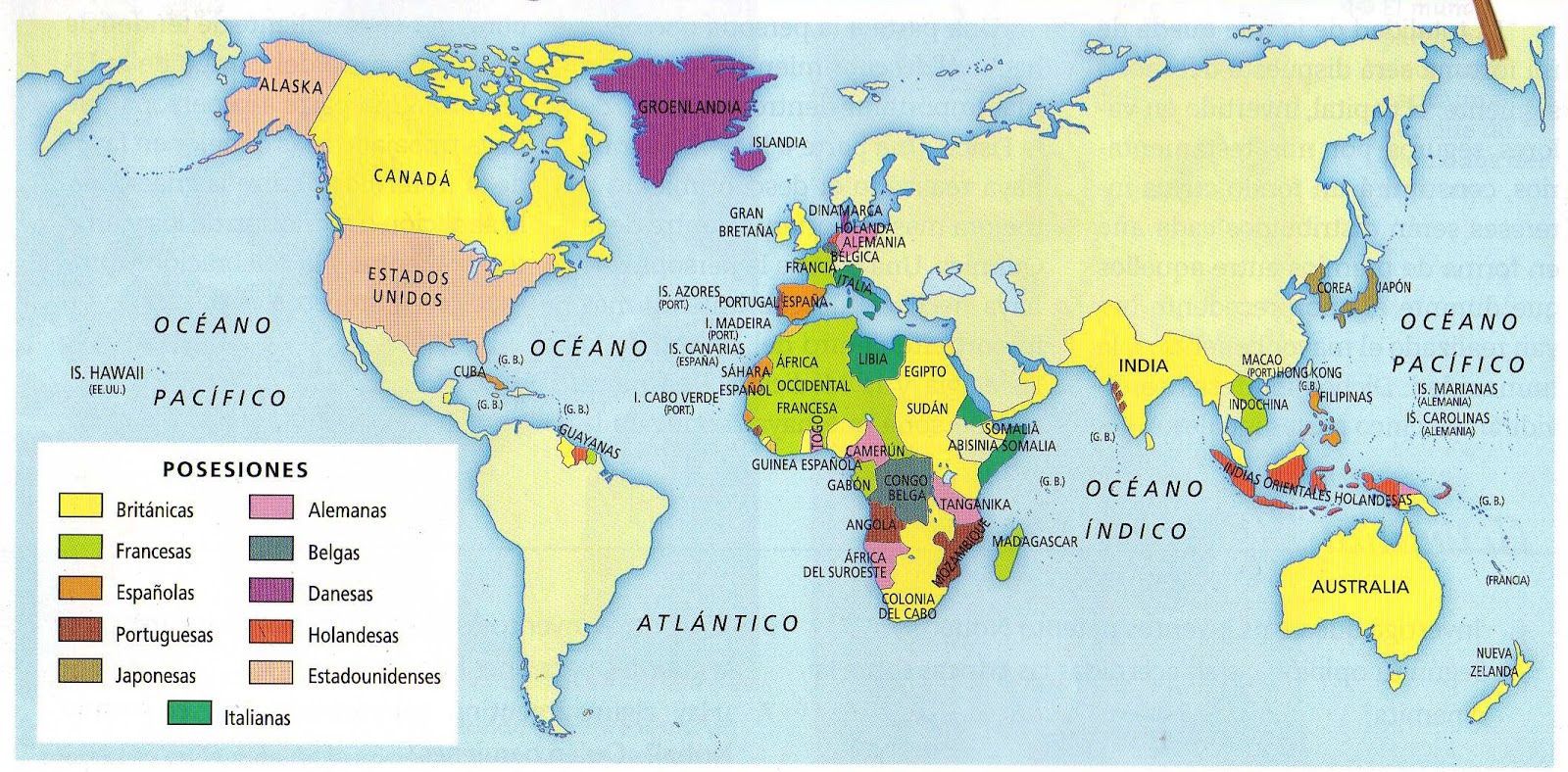
 Understanding in depth the power dynamics operating today requires an understanding of how forms of domination by one culture over another have evolved. This article analyses the origins, similarities and differences between four terms that define different forms of domination, whether territorial, political, economic and/or cultural: empire, imperialism, colonialism and neocolonialism.
Empire refers to a “set of states or territories subjected to another”, generally through military force. In ancient civilizations, empires combined military expansion with mechanisms designed to stabilize conquered areas, offering peace and prosperity in exchange for submission and the payment of taxes.
The term imperialism originated in the 19th century and was initially used in connection with the Napoleonic invasions, although it soon became widespread as a way of describing the behaviour of any empire. The concept has evolved and is currently understood as the control of foreign territories through their direct annexation or through mechanisms of indirect political, economic or cultural control, without necessarily involving their conquest, occupation or subjugation to a permanent foreign government.
Colonialism is the political and economic regime in which a state or government controls and exploits a territory that does not belong to it. The term refers to the phenomenon that developed from the late 15th century to the early 20th century under the European powers. Colonialism involves the conquest of a foreign territory, since it entails assuming control over it, although it does not necessarily involve establishing settlements there. Unlike imperialism, colonialism involves foreign sovereignty and long-term foreign government over the subjected territory. However, it should be noted that the two terms are often used interchangeably in the literature, particularly when referring to the period between the second half of the 19th century and the Second World War. During this period, the development of industrial capitalism and the rise of nationalism contributed to the colonial expansion of the European powers, which divided up the entire African continent and large parts of Asia and Oceania.
Over the centuries, the motivations of the colonizers, initially presented as supposedly “civilizing”, evolved, particularly in the case of Africa, towards the exploitation and domination of the colonies’ resources. Furthermore, this phenomenon spread and was justified through racist ideas which maintained that the colonizing powers belonged to a superior species to that of the colonized powers. These ideas were reinforced through legislation that prevented people originating from colonized territories from accessing rights or acquiring citizenship status on equal terms with the colonizers. Other ideas used to justify domination included the need to absorb the surplus of European population and capital, the desire for power, and economic, technological and military superiority.
Today, there are still 17 territories included on the UN list of Non-Self-Governing Territories pending decolonization. The list is linked to the Special Committee on Decolonization, established in 1961 with the objective of “monitoring and advancing the decolonization process of Non-Self-Governing Territories under the administration of colonial powers with the purpose of ending colonialism”. Among them is Western Sahara, abandoned by the Spanish State in 1976, whose decolonization remains pending. The United Kingdom is the state administering the largest number of Non-Self-Governing Territories, with 10 out of 17.
Neocolonialism refers to the phenomenon of indirect domination experienced by former European colonies at the hands of their former colonial powers after achieving independence. The term emerged in the 1960s to denounce the economic dependence of newly independent states, which had to compete in a world dominated by the former colonial powers. Furthermore, as W. Alade Fawole denounces in his book The Illusion of the Post-Colonial State: Governance and Security Challenges in Africa, these powers introduced economic, political and cultural structures that favoured the continuation of their influence and their access to decision-making in their former colonies.
Unlike colonialism, which is based on direct and, in many cases, military control, neocolonialism presupposes the formal sovereignty of the dominated territory and employs economic, financial and cultural mechanisms to maintain dependency. These include external debt, the dominance of the dollar in international economic relations, unregulated foreign investment, the exploitation and trade of natural resources, and unequal trade. Local elites may act as intermediaries and facilitate this neocolonial penetration by opening the door to foreign interests. In this context, economic exploitation and cultural influence replace military occupation as instruments of domination.
Therefore, imperialism can be considered an umbrella term encompassing colonialism and neocolonialism as different forms of domination. Although some authors reserve the term imperialism for the ideology that justifies the expansion of one state’s power over others, while colonialism would be the implementation of that ideology.
Understanding these differences is fundamental to critically analysing contemporary international relations. Whereas colonialism involves a direct relationship between colonizer and colonized, neocolonialism operates through economic and financial mechanisms that can perpetuate the dependency of countries in the Global South. This concept, popularized after decolonization, helps explain how former colonial powers and new centres of power maintain their hegemony without the need to exercise direct administration. Neocolonialism represents the continuation of certain forms of imperialist exploitation under new forms and constitutes a key tool for understanding persistent inequalities in the world system.
Sources:
-
Real Academia Española (2026). imperio. https://dle.rae.es/imperio?m=form
-
Steinmetz, G. (2014). Empires, Imperial States, and Colonial Societies. En Concise Encyclopedia of Comparative Sociology. Brill. https://websites.umich.edu/~geostein/docs/Steinmetz%202014%20Empires%20imperial%20states%20and%20colonies.pdf
-
Colaboradores de Wikipedia. Imperialismo [en línea]. Wikipedia, La enciclopedia libre, 2026 [fecha de consulta: 14 de agosto del 2026]. Disponible en <https://es.wikipedia.org/w/index.php?title=Imperialismo&oldid=174851432>.
-
Real Academia Española (2026). colonialismo. https://dle.rae.es/colonialismo?m=form
-
El Orden Mundial (2022). ¿Qué es el neocolonialismo?. https://elordenmundial.com/que-es-neocolonialismo/
-
Colaboradores de Wikipedia. Comité Especial de Descolonización [en línea]. Wikipedia, La enciclopedia libre, 2026 [fecha de consulta: 12 de agosto del 2026]. Disponible en <https://es.wikipedia.org/w/index.php?title=Comit%C3%A9_Especial_de_Descolonizaci%C3%B3n&oldid=174811999>.
-
Patrick C. Okpalaeke (2019) The Illusion of the Post-Colonial State:
Governance and Security Challenges in Africa, Canadian Journal of African Studies / Revue
canadienne des études africaines, 53:2, 394-396. https://www.researchgate.net/publication/333975478_The_Illusion_of_the_Post-Colonial_State_Governance_and_Security_Challenges_in_Africa
-
Nacións Unidas (2026). Territorios No Autónomos. https://www.un.org/dppa/decolonization/es/nsgt
-
CATEDU (2026). 4. El imperialismo triunfante. https://e-ducativa.catedu.es/44700165/aula/archivos/repositorio//1250/1288/html/4_el_imperialismo_triunfante.html
-
CATEDU (2026). Tema 3: El Imperialismo. https://e-ducativa.catedu.es/44700165/aula/archivos/repositorio/1250/1289/html/index.html