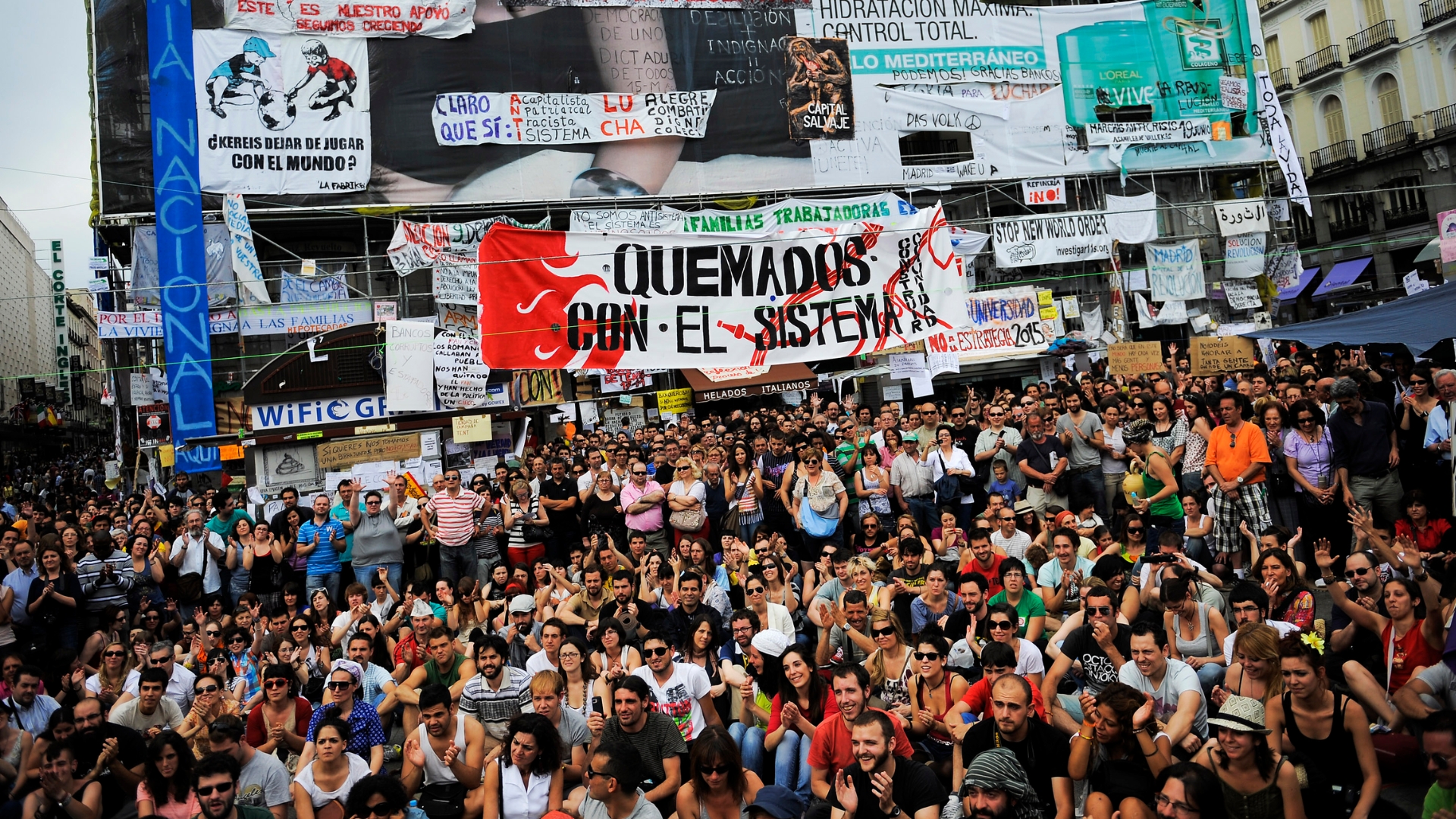
The Spanish State, as is the case throughout the West, is characterised by experiencing a moment of strong social tensions due to the dismantling of the welfare state. It must be borne in mind, however, that the Spanish State has its own particular features that strangle the democratic system, for it has an institutional architecture designed to preserve the status quo inherited from Francoism under an appearance of constitutional normality. The regime of ’78, as this system is popularly known, and all of its main actors (the PSOE-PP bipartisan system, the monarchy, the de facto powers, the economic elites inherited from late Francoism…) form the backbone on which the Spanish State rests, and which prevent its full democratic development. Overcoming it is a necessary condition for popular sovereignty to be something more than a formula in the preamble to the 1978 Constitution.
In his 1969 Christmas speech, the dictator Francisco Franco used the expression “everything is tied up and well tied up” when referring to Juan Carlos I as his successor and, therefore, as guarantor of the regime’s continuity after his death. The consensus that founded the regime was a pact of elites. The 1976 Law for Political Reform was born from the Francoist Cortes, and the 1978 Constitution was sanctioned by a monarch appointed by the dictator who had sworn loyalty to the Francoist National Movement. The Moncloa Pacts disciplined wages and popular expectations in exchange for promises of welfare that capital would soon withdraw. The institutional left, with the PSOE at its head, accepted the monarchy, which is by definition an anti-democratic institution; the 1977 Amnesty Law, which exonerated those responsible for crimes against humanity and for violations of rights and freedoms over 40 years; and a State of Autonomies that neutralised the national aspirations of the different nations within the State. In exchange, the PSOE received a rotation in office that never threatened the real balances of power, for it is a key piece in how the system works and can only survive if the regime is sustained.
The architecture of ’78 shielded the coercive and judicial apparatuses inherited from the dictatorship. The 1977 Amnesty Law equated the victims of Francoism with their executioners, raising a wall against truth, justice and reparation. The judiciary, legitimised by a Constitution that did not purge the structures of the previous regime, today acts as the guardian of an order that criminalises political dissent and protects the hegemony of the system’s main parties (PSOE and PP).
The PSOE-PP bipartisan system is the transmission belt of a regime that manages the rotation of parties in the executive without altering its foundations. Corruption is not an anomaly but a mode of operation built on the logic of Francoism: it is how a system works in which the parties of the turn historically financed themselves (and continue to finance themselves) while serving the great economic interests. The 2008 crisis revealed the fragility of the social pact; the express amendment of Article 135 of the Constitution, the bank bailouts and the cuts demonstrated what the regime’s true hierarchy of priorities was.
Opening a constituent process that allows for a radical shift in the social model is a necessity that must guide all people and organisations seeking a fairer and more democratic system. And to this end, it is an obligation to break completely with the architecture of the Regime of ’78. A new system must be built that changes everything: the form of the State, the territorial model, rights and freedoms, the distribution of wealth, the relationship between the economy and democracy… It is not a matter of reforming the framework, but of replacing it with a real democracy. Bringing down the Regime of ’78 must be the objective to be pursued every day; building a popular democracy, what comes after.