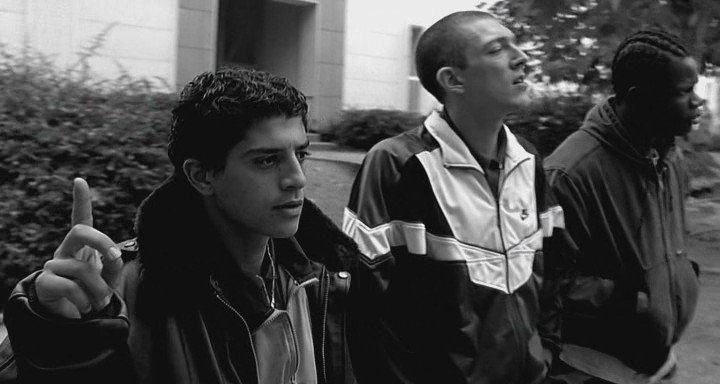
When a society does not want to see the wound, the best thing is to film the pus. Mathieu Kassovitz, at only 27 years old, did that in 1995: he took a black-and-white camera and went into the heart of the Parisian “banlieues” to give viewers an uncomfortable image, that of a France that did not recognise itself in its own outskirts. The film was not born from an aesthetic whim, but from the outrage over the death of Makomé M’Bowole, a teenager shot by police in 1993. That gunshot, silenced by the news, became the trigger for a script written in a few hours and shot as a twenty-four-hour countdown.
The plot presents three friends (Vinz, Hubert and Saïd) in a concrete periphery where the only way out seems to be violence. The plot is simple: the day after a riot, and knowing that their friend Abdel is fighting for his life in a hospital, Vinz swears to kill a policeman if the boy does not survive. What follows is an erratic walk between the neighbourhood and central Paris, a journey that reveals the abysmal distance between the City of Light and the shadows of the “Périphérique”. The monochrome photography is a statement of intent: there are no shades, only chiaroscuro, and the viewer cannot hide behind colour.
Immigration, poverty and violence then wove the everyday landscape of the “cités”. The leading trio (Jewish, Black and Arab) is not a concession to diversity, but a reflection of the forced mixing caused by state neglect. Unemployment rates exceeded 30 % in those neighbourhoods, and the police acted like an occupation army. Kassovitz does not invent anything; he documents. Every insult, every abusive search, every contemptuous look is taken from the statements of residents and associations that had been denouncing “bavures” (police blunders that cost lives) for years, with the state assuming no responsibility.
The director, aware of his role as a megaphone, championed the concept of “edutainment”: learning while having fun, but without trivialising. That is why he chose non-professional or nearly debutant actors (Vincent Cassel, Hubert Koundé, Saïd Taghmaoui) who brought a truth that no acting school could imitate. The film does not judge, but it does not excuse either: it shows how hatred feeds on itself, how daily humiliation turns any gesture into a spark. Hubert’s famous line (“Hatred breeds hatred”) goes beyond a slogan to become a social diagnosis.
In the context of the 1990s, France was experiencing the euphoria of European construction and indifference towards its peripheries. The media treated the “banlieues” as wild territories, and political parties alternated between promises of redevelopment and security rhetoric. “La Haine” arrived like a thermometer that registered a pre-existing fever, and its selection at Cannes (where it won the award for best director) turned it into an uncomfortable phenomenon. Uniformed police officers turned their backs on it during the red-carpet walk, a gesture that confirmed that the wound was real.
Today the film remains an exhausting document because its questions remain unanswered. It offers neither consolation nor recipes, and it limits itself to repeating that initial sentence: “What matters is not the fall. It is the landing”. The abrupt ending, with the sound that cuts the image, is not a conclusion but a realisation: violence is not resolved, it repeats itself. And as long as the political class continues to look the other way, the concrete of Paris will keep producing new “La Haine”.
Sources:
-
Wikipedia (2025). La Haine. URL: https://gl.wikipedia.org/wiki/La_Haine
-
AlloCiné (1995). Fiche technique du film La Haine. URL: https://www.allocine.fr/film/fichefilm_gen_cfilm=11888.html
-
Le Monde (1995). ” La Haine ” ou le malaise des banlieues (arquivo). URL: https://www.lemonde.fr/archives/article/1995/05/22/la-haine-ou-le-malaise-des-banlieues_3872344_1819218.html (referencia xeral)
-
IMDb (1995). La Haine (1995). URL: https://www.imdb.com/title/tt0113247/
-
Télérama (2020). ” La Haine ” : 25 ans après, le film de Kassovitz toujours aussi brûlant. URL: https://www.telerama.fr/cinema/vingt-ans-apres-la-haine-les-cites-toujours-grandes-absentes-des-ecrans,112366.php