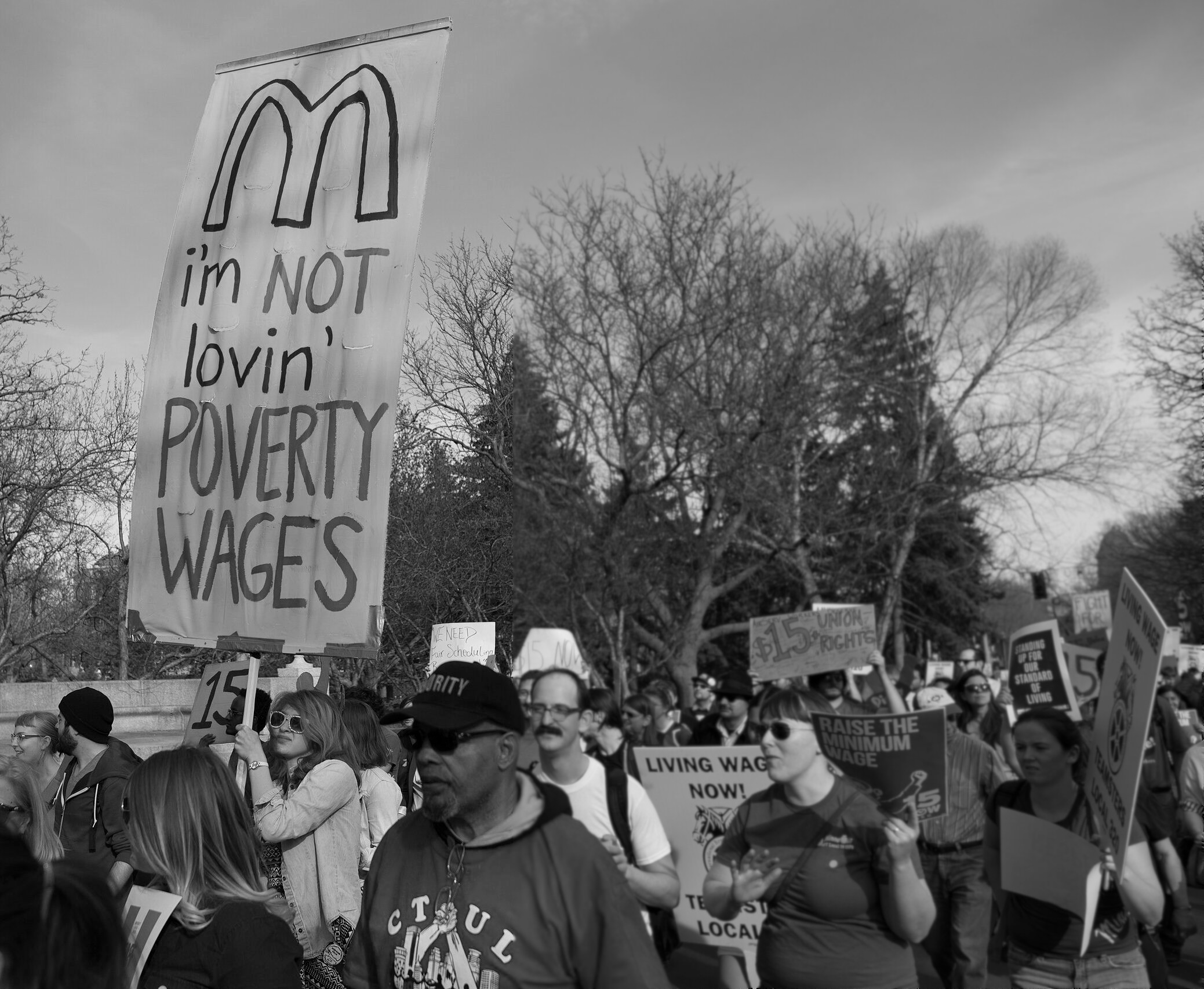
When we look at the present and see how capital profits grow rapidly while the living conditions of the working class stagnate or decline, we understand the need to recover collective memory and avoid the paralysis imposed by individualism. Current rights (such as the eight-hour workday, maternity protection, or equal pay) are the result of organization and social mobilization, not spontaneous concessions. This article revisits five historical milestones that demonstrate the transformative power of organized struggle.
The first major milestone dates back to May 1, 1886, in the city of Chicago. Thousands of workers took part in a massive strike to demand a reduction in working hours, which at the time extended up to 14 or 16 hours a day. The mobilization was summed up in a slogan that today sounds like common sense, but was revolutionary at the time: “Eight hours for work, eight for sleep, and eight for home.” On May 4, during a rally in Haymarket Square, an explosive device (whose origin was never clarified) detonated among police forces, triggering brutal repression that resulted in dozens of workers killed and hundreds injured. The subsequent trial was a sham: eight union leaders were convicted without evidence, four of them executed (Georg Engel, Adolf Fischer, Albert Parsons, and August Spies), and a fifth, Louis Lingg, was found dead in his cell under suspicious circumstances. A few weeks later, employers agreed to grant the industrial sector the eight-hour workday. The sacrifice of these men, known as the Haymarket Martyrs, was not in vain. In 1889, the Socialist Workers’ Congress of the Second International declared May 1st as International Workers’ Day.
In 1917, Brazilian women workers played a major role in the first general strike in the country’s history. The wave of stoppages began in two textile factories in the Mooca neighborhood of São Paulo and quickly spread to cities such as Rio de Janeiro and Porto Alegre, mobilizing around 70,000 people for thirty days. Although men held leadership positions in unions, women made up the majority of the workforce in textile factories and were the ones who introduced two groundbreaking demands: maternity leave and the principle of “equal pay for equal work.” These mobilizations show that feminist struggle did not arise exclusively from privileged classes, but has deep roots in factories, workshops, and streets. Their demands were not ignored: a decade later, Brazil’s Social Legislation Commission incorporated proposals such as maternity leave and the prohibition of night work for women, setting a key precedent across Latin America.
In 1919, the La Canadiense strike in Barcelona led to the reduction of the working day to eight hours, making Spain the second country in the world (after Russia) to establish this standard nationwide.
In January 1922, more than 100,000 sailors and dock workers in Hong Kong, then a British colony, launched a strike that completely paralyzed the port for 56 days. They demanded wage increases and, above all, the right to organize in unions against colonial exploitation. The strike ended in a historic victory: workers achieved wage improvements and union recognition. This milestone awakened political consciousness among the Chinese people and showed that worker unity could challenge the powerful British Empire, opening a cycle of anti-colonial mobilizations across Asia.
On October 24, 1975, 90% of Icelandic women stopped work in factories, offices, schools, and homes. Known as the “Women’s Day Off,” this massive strike made visible the invisible labor (domestic and care work) that sustained the country’s economy. The impact was immediate and lasting. The following year, Iceland passed a law prohibiting wage discrimination based on gender. Five years later, in 1980, the country elected the first female president by democratic vote in all of Europe. This milestone showed that women’s mobilization not only wins specific rights, but transforms the political and social structures of an entire country.
These five examples, from Chicago to Reykjavík, share a clear common thread: all the rights we now take for granted were won through collective struggle, never granted by elites. However, today we face a dangerous paradox. While capital profits grow exponentially and wealth concentrates in few hands, the living conditions of the working class are stagnating or even worsening. Precarity, wage gaps, inflation, and the housing crisis are not accidents: they are consequences of a system that requires isolated, indebted, and memoryless workers. The individualism promoted daily is a poison for the working class. It serves to paralyze us and make us believe that our situation is solely an individual responsibility, and that organizing is useless. History proves otherwise. Recovering collective memory is not nostalgia; it is a tool of defense. Because without memory there is no dignified future, and without organization there is no power to transform reality.
References
-
Sin Embargo. A 135 años del 1 de mayo. https://www.sinembargo.mx/3970471/a-135-anos-del-1-de-mayo/
-
National Geographic. La revuelta de Haymarket y los derechos laborales. https://historia.nationalgeographic.com.es/a/revuelta-haymarket-y-derechos-laborales_15292
-
Público. Revuelta de Haymarket: los mártires de Chicago y el mayor complot judicial de Estados Unidos. https://www.publico.es/culturas/revuelta-haymarket-martires-chicago-historia-mayor-complot-judicial-estados-unidos.html
-
Wikipedia. Jornada de ocho horas. https://es.wikipedia.org/wiki/Jornada_de_ocho_horas
-
El Plural. La jornada laboral de 8 horas: la huelga contra las eléctricas hace 102 años. https://www.elplural.com/sociedad/jornada-laboral-8-horas-huelga-contra-electricas-hace-102-anos_276382102
-
Universidade Estadual de Campinas (Unicamp). Tese revela luta das brasileiras por direitos civis e trabalhistas. https://www2.unicamp.br/unicamp/ju/noticias/2017/05/09/tese-revela-luta-das-brasileiras-por-direitos-civis-e-trabalhistas/
-
Partido dos Trabalhadores. Mulheres foram a linha de frente da primeira greve geral da história do país. https://pt.org.br/mulheres-foram-a-linha-de-frente-da-primeira-greve-geral-da-historia-do-pais/
-
Editora FGV. Os direitos das mulheres: feminismo e trabalho no Brasil (1917-1937). https://editora.fgv.br/produto/os-direitos-das-mulheres-feminismo-e-trabalho-no-brasil-1917-1937-3311
-
Lausan Collective. Hong Kong political strikes: a brief history. https://lausancollective.com/2019/hong-kong-political-strikes-brief-history/
-
Malay Mail. The day women stopped. https://www.malaymail.com/news/what-you-think/2024/11/23/the-day-women-stopped-diana-abdul-wahab/157759