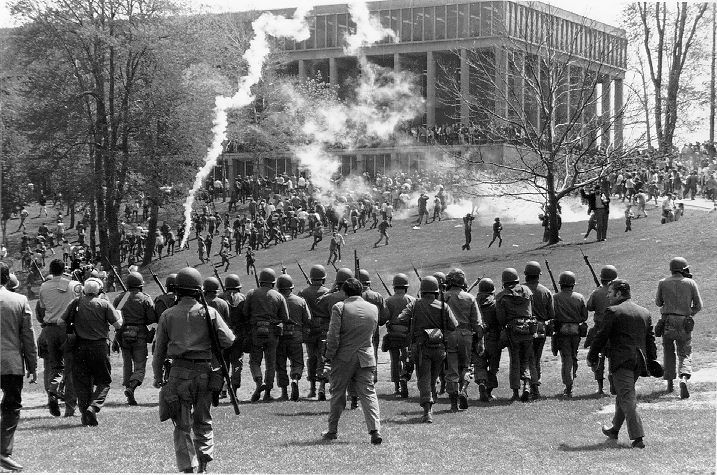
On May 4, 1970, the Ohio National Guard opened fire for thirteen seconds against a peaceful protest against the US invasion of Cambodia at Kent State University. The so-called Kent State massacre resulted in four students dead and nine others injured. The massacre took place under the presidency of Richard Nixon and triggered a wave of student strikes that forced the closure of hundreds of universities across the country. Popular outrage was immediate, and the social and artistic response was not long in coming.
In this context of shock, Neil Young composed “Ohio” after seeing the images of the massacre in “Life” magazine. The musician, who was in Northern California with his partner David Crosby, picked up his guitar, withdrew, and returned a few hours later with the complete song. The lyrics, direct and uncompromising, denounce state violence: “Tin soldiers and Nixon coming, we’re finally on our own, …… Four dead in Ohio”.
Crosby, Stills, Nash & Young recorded the track on May 21, 1970 at the Record Plant studio in Hollywood, just days after the tragedy. The urgency was extreme: the band decided to release the single immediately, even though their other track “Teach Your Children” was climbing the charts, because they felt they could not remain silent in the face of that tragic event.
The song’s impact was immediate and massive. “Ohio” reached good positions on the music charts and became an anthem of the anti-war movement. However, its reception was not without controversy. The president, who had called the protesters “vandals”, expressed his anger at the song, and numerous AM radio stations, especially in the state of Ohio, banned its broadcast for directly challenging the Nixon administration.
Despite the censorship*, “Ohio”* found its space on college and underground FM radio stations, becoming a symbol of the counterculture. Its influence transcended music: the song immortalised the memory of Allison Krause, Jeffrey Miller, Sandra Scheuer and William Schroeder, the four deceased students, and helped keep alive the movement that demanded political accountability at a time of deep social polarisation.
Half a century later, “Ohio” still resonates strongly. The track experienced a resurgence in 2024, when pro-Palestinian protesters on US college campuses reclaimed the song as a symbol of protest. Its message, as heartbreaking as it is current, continues to remind us of the human cost of political decisions as well as the need to act and raise one’s voice against injustice.