Enshittification of digital content platforms has ceased to be a suspicion and become a reality as evident as it is unbearable. The reaction of digital citizens is predictable: piracy is once again a rational tool for accessing culture and, above all, for preserving digital heritage.
The phenomenon has figures. Global visits to piracy sites went from 130 billion in 2020 to more than 216 billion in 2024 (MUSO), a 66% increase. In 2025 there was a decrease to 185.6 billion, but the underlying trend consolidated in 2026. Netflix, Disney+ and Prime Video applied sustained price increases that, added together, make digital leisure between 5 and 10 euros per month more expensive per household, while consolidating ad-supported tiers and cracking down on account sharing. Catalog fragmentation (which forces paying for four or more platforms to access the content) and the disappearance of titles from libraries break the illusion of a stable digital repository. The result: subscription fatigue that pushes back toward the “BitTorrent” protocol.
In the world of video games, the DRM battle was fought with cruel irony. Denuvo, the most widely used anti-piracy system since 2014, was considered practically unbreakable. In April 2026, the Reddit thread tracking protected games without a “crack” reached zero: all single-player titles with Denuvo already had a functional pirated version. The “MKDev” collective, together with developer “DenuvOwO”, released a program that tricks “Denuvo” into believing it is communicating with an authorized system, while the cracker “voices38” removes the system entirely. The response from Denuvo and 2K Games was to introduce mandatory online checks every 14 days, a “digital ticket” that expires and prevents starting the game without a connection. Someone who legally bought a game for 70 euros finds they cannot play on a train, while pirates enjoy a version without restrictions. The logic of aggressive DRM always punishes those who pay.
For those who want to take another path, specific tools exist. In the realm of “torrents”, qBittorrent is the free client par excellence, compatible with Windows, macOS, Linux and even portable versions that require no installation. It should be noted that downloading it is legal, but exchanging material protected by copyright can lead to sanctions in Germany, where a single film can generate fines of between 700 and 1,000 euros (although the limitation is solved with a VPN). We only need to find a site with legitimate torrents, click the “magnet” link and the content will be available in a few minutes.
As an alternative for older “P2P” networks, there are eMule (Windows) and aMule (Linux), which keep alive the philosophy of sharing files without depending on centralized servers. This software was recently updated, offering up to 380 times faster download speeds in laboratory tests.
In online video, NewPipe is a lightweight, open-source client for Android distributed through F-Droid that allows playing YouTube videos without ads, with background playback and without needing a Google account. It does not use the platform’s official API; instead, it extracts information directly from the web, making it a robust and privacy-respecting alternative. For those who prefer a desktop browser, uBlock Origin remains the reference tool for blocking ads on YouTube, although its full functionality is practically restricted to Firefox, since Chrome and Edge dropped support for the “Manifest V2” architecture.
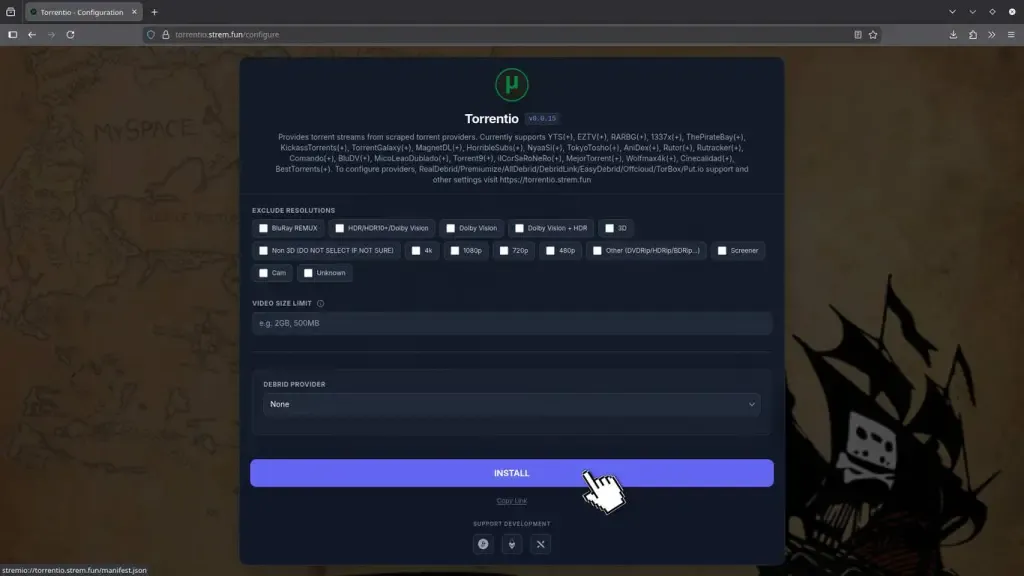
Those with more advanced knowledge can combine Stremio with an add-on such as Torrentio, which acts as an aggregator of links from multiple providers. This configuration centralizes on-demand playback in a single application. For Android applications in general, UpToDown offers an alternative store that allows downloading APKs without depending on Google Play or restricted regions, and free of charge for many paid applications.
In the gaming world, figures the community now considers legendary have emerged: the “repackers”, such as “FitGirl”, “DODI” and “ElAmigos”, who occupy a central place in the preservation and distribution of video games. These groups do not “crack” games: they compress them intensively to reduce download size and, in many cases, offer versions that work better than the originals, since they remove the “DRM” checks that degrade performance. Their existence shows that the community seeks not only free access but control over its own technical experience. It is worth remembering that fake sites with .org, .co or .com extensions may contain “malware”: reliable sources are https://fitgirl-repacks.site, https://dodi-repacks.site and https://elamigos.site.
Free culture has a marked date. Every 12 October, the International Day Against “DRM” is celebrated, established in 2013 by the Free Software Foundation to raise awareness about technologies that limit legitimate access to content. Digital preservation is a strong argument: platforms such as GOG argue that if the installer is downloaded and saved on a disk, the game is forever for whoever bought it. When Netflix removes a series or when Denuvo shuts down its servers, piracy becomes the last archive of digital culture.
Learning to pirate content is a rational response to a system that betrayed its promise. The tools exist, they are accessible and, in many cases, they offer a better experience than legal platforms.
Sources
-
MUSO (2024-2025). What 216 billion visits to piracy sites reveal about global media. https://www.muso.com/blog/what-216-billion-visits-to-piracy-sites-reveal-about-global-media-in-2024
-
China Business Knowledge (2026). How to keep digital pirates at bay?. https://cbk.bschool.cuhk.edu.hk/how-to-keep-digital-pirates-at-bay/
-
ActualTV (2026). El streaming toca techo en España. https://actualtv.es/el-streaming-toca-techo-en-espana-cuanto-cuesta-mantener-varias-plataformas-y-por-que-las-subidas-de-precio-estan-frenando/
-
Korben.info (2026). Denuvo finally bypassed on all its single-player games. https://korben.info/en/denuvo-bypassed-all-single-player-games.html
-
Yahoo Tech (2026). Denuvo has been cracked in all single-player games. https://tech.yahoo.com/gaming/articles/denuvo-cracked-single-player-games-100000236.html
-
ITMR Legal (2026). Filesharing-Abmahnung 2026. https://itmr-legal.de/blog/filesharing-abmahnung
-
Computer Hoy (2026). El mítico aMule 3.0.0 vuelve a la vida. https://computerhoy.20minutos.es/software/amule-3-0-0-vuelve-nuevsa-actualizacion-descargas-p2p_6981340_0.html
-
Disroot (2026). Firefox is now the last major browser that still supports uBlock Origin. https://lm.disroot.org/post/scribe.disroot.org/10729801
-
Time.now (2026). International Day Against DRM. https://time.now/events/international-day-against-drm/
-
GOG.com (2026). GOG Preservation Program. https://www.gog.com