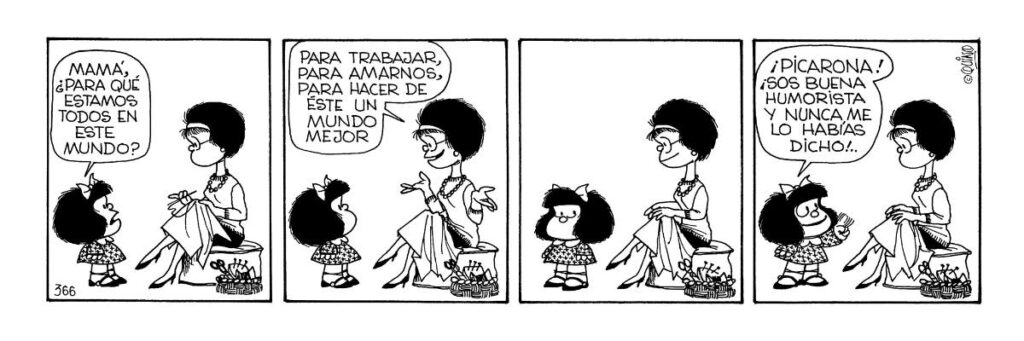
Mafalda turns 62 in 2026 while political humour dissolves into algorithms. In September 1964, the Argentine magazine “Primera Plana” published the first strip of a six-year-old girl who hated soup and asked uncomfortable questions. Joaquín Salvador Lavado Tejón, known as Quino, born in Mendoza in 1932, had spent years selling drawings without much success. That character became one of the most influential critical voices in Latin American culture.
The strip was born in a context of military dictatorships, the Cold War and social radicalisation in Latin America. Quino grew up in a politicised family and always acknowledged that all his work was political: “I have always tried to expose the scheming of power with my humour strips”, he told the newspaper “El País” in 2003.
Mafalda’s humour did not seek easy laughter. Quino himself described his style as “using the scalpel” rather than tickling. His surgical irony reduced the absurdity of power to childish questions that disarmed any dominant discourse. Soup, the character’s eternal object of hatred, was an allegory of military regimes, as the author explained.
The author had already warned in 2025 in an interview of his diagnosis: “People have lost interest in political caricature”. Around 2001, he stated that “today humour cannot ‘open minds’, everything that happens is so obvious that we humourists have been left without our script of social and political moralism”. The prophecy came true: today the meme does not open minds, it only entertains them while filling them with contempt.
Mafalda herself warned in a strip: “By saving so much on education, we became millionaires in ignorance”. She made you think because she asked, not because she insulted. Today politics is made for a less educated part of the citizenry because the humour that accompanies it no longer seeks to enlighten more than it seeks to humiliate.
Political humour like Quino’s worked because it trusted the intelligence of the reader. That is the key difference between a meme and a strip by Quino: the first wants you to share it; the second, to reflect.
Sources
-
Sitio oficial de Quino: https://www.quino.com.ar
-
Naranjo, Carmen. “Quino y Mafalda”. SINABI. https://www.sinabi.go.cr/biblioteca digital/articulos/naranjo carmen/Quino y Mafalda.pdf
-
“De Ucrania a la crisis política, las lúcidas sentencias con las que Mafalda se adelantó a su tiempo”. ABC. 26/02/2022. https://www.abc.es/cultura/abci-ucrania-crisis-politica-lucidas-sentencias-mafalda-adelanto-tiempo-202202260017_noticia.html
-
“España al borde de un ataque de algoritmos”. El País. 02/06/2026. https://elpais.com/opinion/2026-06-02/espana-al-borde-de-un-ataque-de-algoritmos.html
-
“La gente ha perdido interés en la caricatura política: Quino”. La Lupa. 08/10/2025. https://lalupa.mx/2025/10/08/la-gente-ha-perdido-interes-en-la-caricatura-politica-quino/
-
Iglesias Kuntz, Lucía. “Quino, el humor libre”. El Correo de la UNESCO. https://www.unisalento.it/documents/20152/7393846/Entrevista_Quino_Unesco.pdf/ac2a58d6-713a-b7c0-0dea-5e8e9237ce96