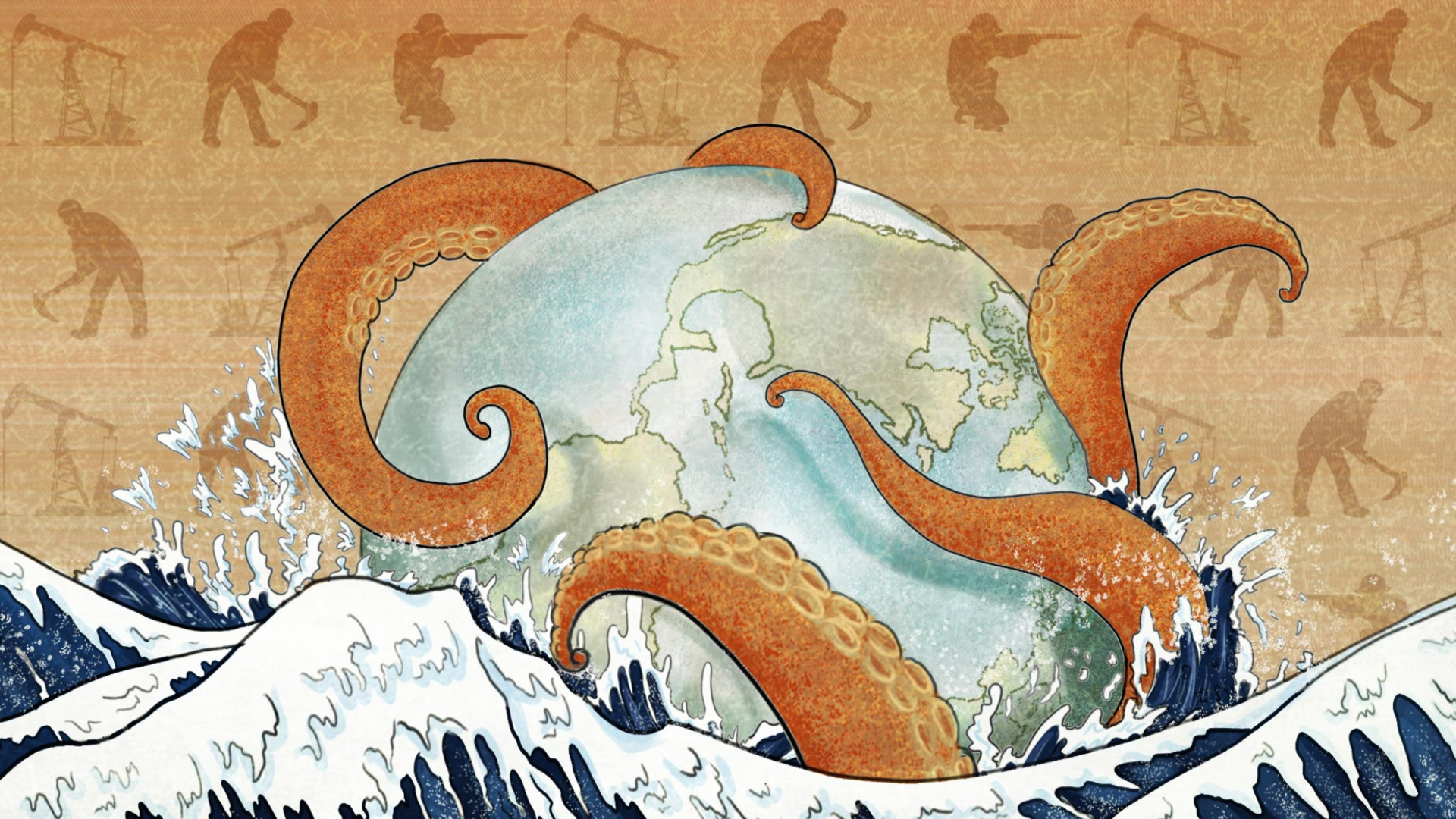
Imperialism cannot be explained by the search for markets alone. Competition between powers, national prestige and control over routes and resources shaped a global system of domination whose logics persist today in renewed forms.
Between 1884 and 1914, European powers partitioned around a quarter of the planet’s surface. Geopolitical rivalry between powers acted as one of the central drivers of that process, which led to the partition, plunder and exploitation of Africa and Asia in a process that combined economic interests, geopolitical rivalry and an ideological justification based on social Darwinism. The milestones of that period shaped a world map whose artificial borders and dependencies still persist today.
These mechanisms crystallised into a known institutional framework. The Berlin Conference (1884-1885), convened by German Chancellor Otto von Bismarck, established the rules for international recognition of possessions in Africa: to claim sovereignty, it was necessary to demonstrate effective occupation and notify the other powers. No African representative took part in the negotiations. The partition was not closed in Berlin, but the conference set what became known as the “Scramble for Africa”.
In Africa, in 1885, the Congo Free State was created, brutally exploited by Belgium to extract rubber and ivory, and whose death toll estimates range between one million and fifteen million, from violence, famine and disease. In 1898, Franco-British rivalry crystallised in the Fashoda incident, whose clash on the upper Nile nearly triggered open war, but was resolved with the French withdrawal and the consolidation of British dominance. In 1899 the Boer War began, lasting until 1902, pitting the British Empire against Dutch-descended settlers for control of South African gold and diamonds.
In Asia, the Opium Wars (1839-1860) forced China to open ports and cede Hong Kong through the so-called “Unequal Treaties”. The Indian Rebellion (1857-1858), which triggered an armed uprising against the rule of the British East India Company, led the British Crown to assume direct control of India. The Boxer Uprising (1899-1901), a popular movement that was strongly xenophobic and anti-imperialist, in northern China was crushed by a coalition of eight powers.
There are three mechanisms directly related to the imperialist process: the pursuit of prestige through territorial expansion, the budgetary pressure derived from war between states, and the consolidation of interest groups with a permanent imperial vocation (that is, armies and navies, mainly).
A first mechanism was the pursuit of relative prestige through territorial expansion. In a zero-sum international system, the acquisition of colonies signalled status and power capacity. As the occupation of territories in Europe proved costly against rivals with comparable military technology, the powers directed their expansion towards spaces where the asymmetry of force was favourable. This demonstration effect fuelled a race to accumulate dominions before competitors did.
To this was added budgetary pressure derived from war between states. Armed conflicts generated high deficits, and governments sought sources of tax revenue in the colonies through tariffs and trade. Although not all colonial projects proved profitable, the widespread belief in their lucrative potential was enough to justify expansion. Political and military competition thus translated into fiscal appetite over foreign territories.
The third factor was the consolidation of interest groups with a permanent imperial vocation. Armies and, above all, navies developed their own agendas: they needed a purpose in peacetime to legitimise access to the resources the state allocated to them. Colonial expansion, which required military superiority, became their natural field of relevance.
On the theoretical plane, Lenin systematised in 1917 the connection between monopoly and imperialist politics. Financial capital, fused with industrial capital, exported capital to the periphery to control production processes and extract rents. Monopoly implied a power of a dictatorial character that needed force to guarantee rentier expropriation. The political form would change over time, but the logic of monopolistic control persisted.
Today, imperialism no longer requires territorial occupation to operate. Capital now needs economic spaces rather than territories: trade rules, financial mechanisms and business law above the law of peoples. The United States plays a specific role through political and military hegemony, while the European Union and Japan maintain complementary imperialist functions. Moreover, other theorists add that financialisation has genuinely deepened dependency: peripheral countries subject their economies to the profitability rules of the financial system in order to access credit.
Imperialism is a form of political power exercised through economic, political, military, cultural and institutional means. Competition between powers, national prestige and control over strategic spaces continue to operate, even though the tools have shifted from the cannon to the financial contract and from colonial administration to macroeconomic conditionality.
Sources
-
El Orden Mundial. (2021). ¿Qué es el imperialismo? https://elordenmundial.com/que-es-imperialismo/
-
Politize!. (2025). Imperialismo: qué es, causas y características. https://politize.org.ar/imperialismo-que-es-causas-y-caracteristicas/
-
Houtart, F. (2007). Los aspectos actuales del imperialismo. https://www.nodo50.org/cubasigloXXI/taller/houtart_300607.html
-
Gedar. (2024). El imperialismo, en un sentido político. https://gedar.eus/es/arteka/inperialismoa-zentzu-politiko-batean
-
Bundeszentrale für politische Bildung (2024). Kolonialismus und Dekolonisation. https://www.bpb.de/system/files/dokument_pdf/IzpB_338_Kolonialismus_Dekolonisation_barrierefrei.pdf
-
Portal Diplomático do Ministerio dos Negócios Estrangeiros de Portugal (s.d.). Conferência de Berlim. https://portaldiplomatico.mne.gov.pt/relacoesbilaterais/paises-geral/conferencia-de-berlim
-
National Geographic (2026). Hoe koning Leopold II Congo tot zijn persoonlijke bezit maakte. https://www.nationalgeographic.nl/geschiedenis-archeologie/a72540266/leopold-ii-persoonlijk-bezit-congo
-
OCLC Research (s.d.). Congo Free State. https://researchworks.oclc.org/archivegrid/
-
Retronews (2019). La crise de Fachoda en 1898 : choc des impérialismes français et anglais. https://www.retronews.fr/colonies/echo-de-presse/2019/11/24/la-crise-de-fachoda-en-1898
-
Radio France (2020). 1898 : Ironie et courtoisie militaire durant la crise de Fachoda. https://www.radiofrance.fr/franceinter/podcasts/archives-secretes/1898-ironie-et-courtoisie-militaire-durant-la-crise-de-fachoda-5861309
-
Lex – Danmarks Nationalleksikon (2024). Boerkrigen. https://lex.dk/Boerkrigen
-
Wikipedia (s.d.). Guerras del Opio. https://es.wikipedia.org/wiki/Guerras_del_Opio
-
Biblioteca Nacional de Portugal (s.d.). Estado Livre do Congo. https://urn.bnportugal.gov.pt/nca/unimarc-authorities/html?id=1818898
-
Vogler, J. P. (2022). How Europe’s history of interstate rivalry is linked to global imperialism – and why it still matters today. LSE European Politics Blog. https://blogs.lse.ac.uk/europpblog/2022/07/27/how-europes-history-of-interstate-rivalry-is-linked-to-global-imperialism-and-why-it-still-matters-today/
-
Bundeszentrale für politische Bildung (2024). Kolonialismus und Dekolonisation. https://www.bpb.de/system/files/dokument_pdf/IzpB_338_Kolonialismus_Dekolonisation_barrierefrei.pdf
-
Otto-von-Bismarck-Stiftung (2025). Die Berliner Afrika-Konferenz 1884/85. https://www.bismarck-stiftung.de/tag/kolonialismus/
-
Instituto de Pesquisa Econômica Aplicada (s.d.). A economia mundial como ponto de partida (sobre Lenin e o imperialismo). https://repositorio.ipea.gov.br/bitstream/11058/13301/1/A_economia_mundial_como_ponto_de_partida.pdf
-
Houtart, F. (s.d.). Los aspectos actuales del imperialismo. https://www.pvp.org.uy/houtart.htm
-
Boron, A. (2002), citado en Beigel, F. (s.d.). Las teorías de la dependencia y el imperialismo. CLACSO. https://biblioteca.clacso.edu.ar/clacso/becas/20140227054137/C05FBeigel.pdf