The struggle for decent housing has been a constant feature of Spain’s recent history. From the earliest protests against evictions to the current demonstrations against property speculation, neighbourhood and citizens’ movements have marked key milestones in the fight for this fundamental right.
One of the largest mobilisations took place in 1931, when the CNT called a rent strike in Barcelona in response to the mass evictions caused by the 1929 crisis. Around 100,000 families joined the strike for eight months, in a struggle that was harshly repressed and ended with the imprisonment of the strike committee and an agreement with the landlords in 1932.
In the 1950s, people who migrated en masse from the countryside to the city had to settle in outlying neighbourhoods lacking basic services. It was women who led the fight to secure infrastructure and who built the neighbourhoods practically from scratch.
During the transition, neighbourhood associations took on a leading role. In September 1977, Madrid was the scene of four historic demonstrations that brought together nearly 300,000 people demanding urban improvements and protesting against the Francoist local councils. A year later, Article 47 of the 1978 Spanish Constitution enshrined the right to decent housing, an article that remains unfulfilled to this day.
In the 1980s, inspired by the English squatter movement, the ‘okupa’ movement emerged in Spain as a tool for political and social protest. It was not merely about occupying a building, but about highlighting the lack of access to housing and community spaces and proposing self-managed alternatives.
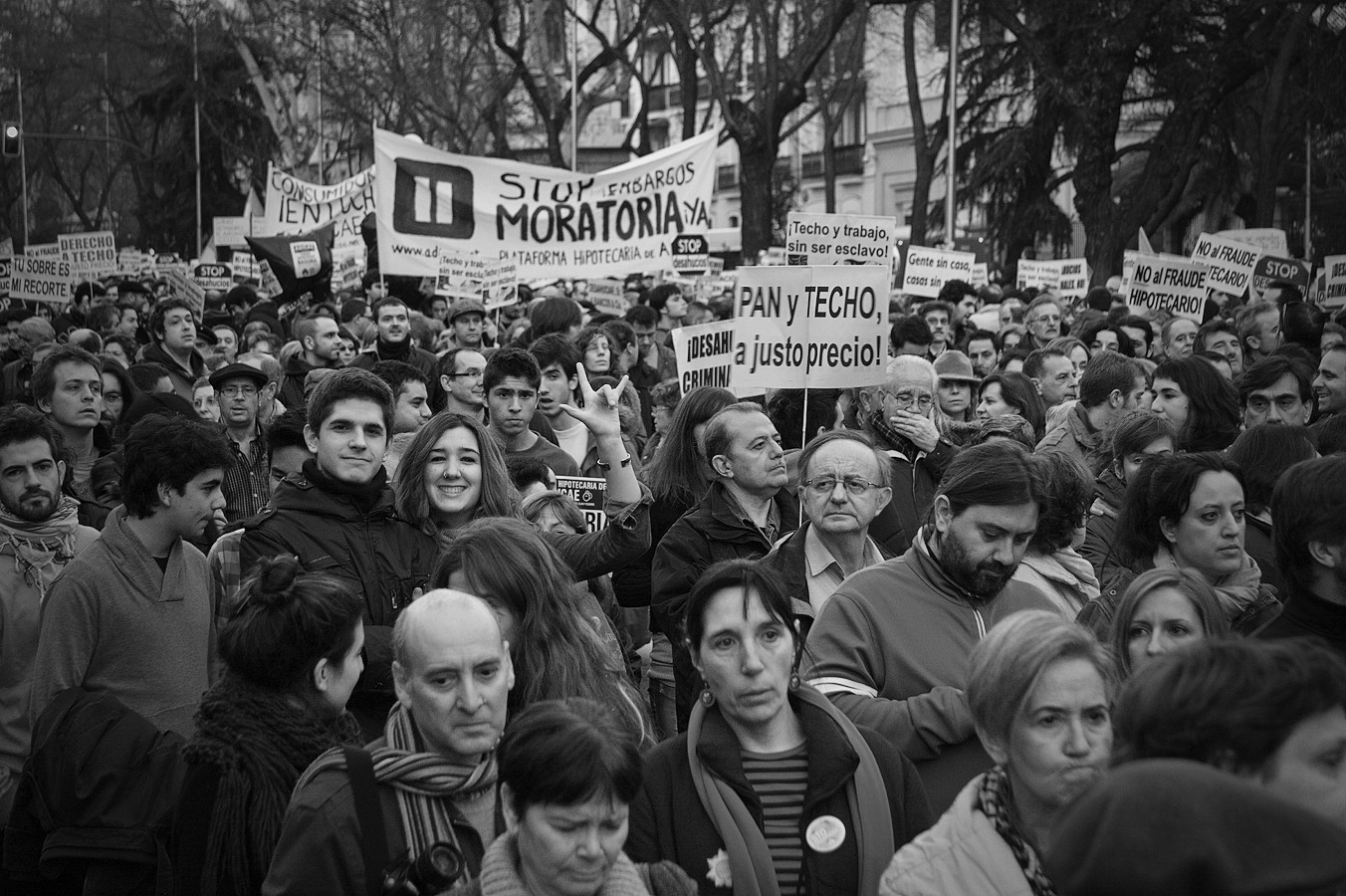
The property bubble and the subsequent financial crisis of 2008 once again placed housing at the centre of the debate. In 2006, V de Vivienda organised periodic, unannounced sit-ins in several cities; in Madrid, thousands of young people occupied the Puerta del Sol in an action considered the precursor to the 15M movement. Shortly afterwards, in 2009, the Platform for People Affected by Mortgages (PAH) was founded in Barcelona, popularising campaigns such as ‘Stop Evictions’ and direct actions such as protests against politicians. The PAH managed to halt more than two thousand evictions and force legislative changes.
Today, soaring rent prices and the activities of investment funds have shifted the focus of the struggle from mortgages to rents. Housing and tenants’ unions, which have emerged strongly since 2017, are confronting financial speculation, the expansion of tourist flats and abuses by landlords, in a new phase of the historic struggle for the right to housing.
References:
- CNT. ‘The 1931 Rent Strike in Barcelona’. Union publications.
- Metropolitan Observatory. ‘The Struggle for Housing in Spain’. Madrid, 2013.
- Platform for People Affected by Mortgages. ‘PAH Report’. Official website.
- ElDiario.es. ‘Chronology of the struggle for housing’. Various authors.