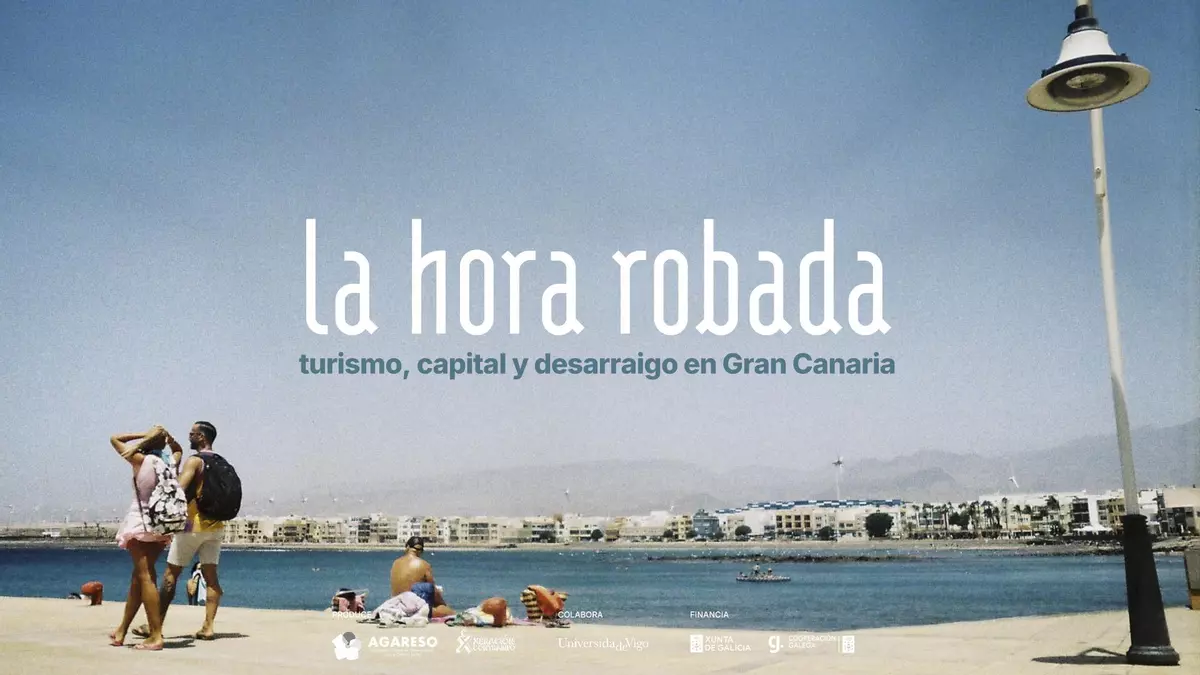
The Asociación Galega de Comunicación para o Cambio Social (AGARESO) premieres the documentary “La hora robada. Turismo, neocolonialismo y desarraigo en Gran Canaria”, an audiovisual work that examines the social and territorial consequences of the current tourism model on the island. The 35-minute piece was developed במסגרת the course “Comunicar para o cambio” and involved a team of five filmmakers traveling to Gran Canaria for five weeks.
The project was initially conceived to address migration routes to the Canary Islands, but the team shifted its focus after identifying a strong social movement around access to housing and extractivist development models.
The documentary gives voice to grassroots organizations denouncing the loss of living space and the difficulty of accessing adequate housing. “Derecho al Techo”, “Guanarteme se Mueve”, “Las Kellys Gran Canaria”, and “La Aldea Sostenible” highlight how tourism pressure restricts access to housing and worsens living conditions for local residents.
Filmmakers Mica Pavone, Alejandra Ceballos, Andrea Oyagüe, and Sara Gestal, together with coordinator Pablo Santiago, present testimonies illustrating the displacement of residents from neighborhoods such as Guanarteme (Las Palmas de Gran Canaria) due to real estate speculation and the spread of short-term tourist rentals.
The documentary also explores the contradictions of the island’s economic model. Growth in the service sector has not translated into improved living standards: working in tourism does not guarantee the ability to afford rent. According to Pablo Santiago, this is one of the regions with the highest levels of severe poverty, where many people struggle to cover basic expenses. As a result, the film positions itself more as a political tool for raising awareness than as a conventional cultural product.
In environmental terms, “La hora robada” examines the Chira-Soria hydroelectric power project as a major infrastructure initiative. The project involves a pumped-storage system between two reservoirs, where desalinated seawater would be pumped up to altitudes of up to 900 meters to generate electricity during peak demand. However, the documentary presents critical perspectives that question a development model prioritizing large-scale investments and external interests, without addressing the structural problems faced by the local population.
Alongside this project, the film analyzes other cases of tourism expansion in water-scarce areas, increasing pressure on natural resources. These dynamics are framed as part of an extractivist model that prioritizes economic profit over sustainability and community well-being.
The central idea running through the documentary is captured in the statement: “We feel like foreigners in our own land”.
After premiering in Las Palmas de Gran Canaria, the film toured various locations across the Spanish State. These screenings are designed as spaces for debate and community engagement, aiming to turn the documentary into a tool for social organization and public awareness in a context of growing mobilization against the dominant tourism model.
References:
-
La Voz de Lanzarote (2026). A documentary on tourism in the Canary Islands: “We feel like foreigners in our own land” #Ekonomus. https://www.lavozdelanzarote.com/en/ekonomus/tourism/documentary-about-tourism-in-the-canary-islands-we-feel-like-foreigners-in-our-land_241600_102.html
-
Canarias7 (2026). La turistificación de Canarias llega a la pantalla y salta a la península. https://www.canarias7.es/politica/turistificacion-canarias-llega-pantalla-salta-peninsula-20260309073000-nt.html
-
A Movida (2026). A Nubeira acolle a proxección dun documental sobre o macroturismo en Gran Canaria. https://amovida.gal/events/proxeccion-la-hora-robada/