The term “fascism” comes from the Latin fasces, which in ancient Rome referred to a bundle of rods tied around an axe. This symbol represented the authority and power of magistrates to punish citizens, as well as the strength that comes from unity: a single rod can be easily broken, but a bundle is unbreakable. The Italian word fascio (bundle) gave its name to the “Fasci di Combattimento”, founded by Benito Mussolini in Milan on March 23, 1919, deliberately reclaiming this symbol of power and cohesion.
Fascism as a political phenomenon emerged in the post–World War I crisis context. Italy, despite being on the winning side, faced economic paralysis, high unemployment, and frustration over the so-called “mutilated victory” (the failure to obtain promised territorial gains). The bourgeois fear of a communist revolution, like the Russian one, combined with the discredit of the liberal state, created fertile ground for Mussolini—formerly a socialist turned ultranationalist—to promise order and national rebirth.
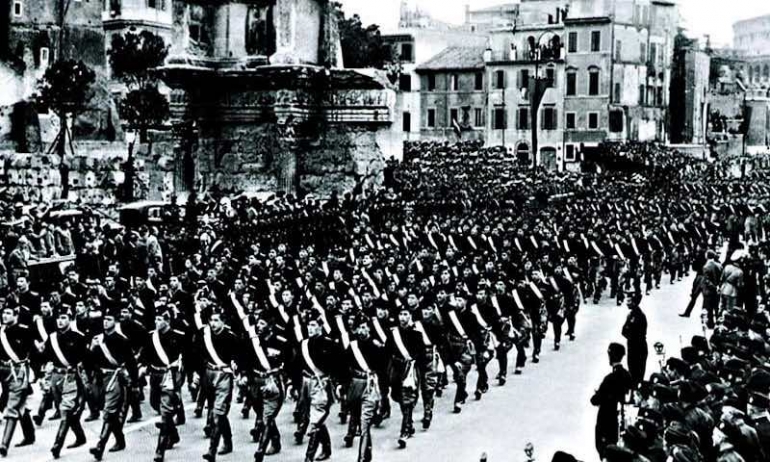
The movement grew through the violence of its “squadre d’azione” (action squads). These groups, also known as the “Blackshirts”, were composed of fascist militants who used violence to intimidate, attack, and eliminate political opponents, especially socialists, communists, and trade unionists. While their origins lie in the Po Valley, funded by large landowners to crush peasant strikes, it was with the March on Rome in 1922 that the squadristi gained national and international prominence.
However, the ideological roots of fascism predate the 20th century, in what is known as proto-fascism. Throughout the 19th century, various thinkers laid the groundwork upon which Mussolini would later build. Among them were Joseph de Maistre (advocacy of divine hierarchy and violence as a pillar of social order), Charles Maurras (authoritarian nationalism), and Houston Stewart Chamberlain (Aryan racism).
Georges Sorel (promotion of violence as a regenerative force) and Friedrich Nietzsche (critique of Christian morality and exaltation of the will to power) also influenced fascist aesthetics. In Germany, figures such as Paul de Lagarde and Julius Langbehn were, according to historian John Weiss, “indistinguishable from Nazi ideologues”, promoting racial Darwinism and the elimination of those deemed inferior. In Italy, the poet Gabriele D’Annunzio embodied proto-fascism through the occupation of the city of Fiume in 1919, establishing a theatrical-style government with rituals, uniforms, and incendiary speeches later adopted by Mussolini.