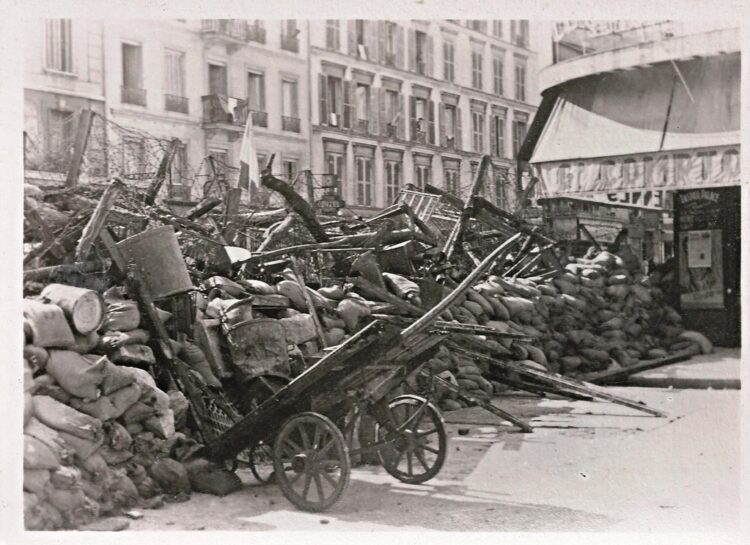
Barricades were and are a recurring element in urban conflicts. It is important to understand their origin and development in order to comprehend their historical and current function.
The barricade was born in Paris in 1588 during the Day of the Barricades, an episode of the eighth war of religion in France. Parisians used barrels filled with earth and stones to block the streets and defend themselves from the troops of King Henry III. This construction system gave the object its name and marked its first documented use as an improvised urban fortification.
During the 19th century, barricades became a symbol of working-class and social struggle. In the Revolution of 1830 and in the Paris Commune (1871), insurgent people perfected the techniques: structures were built with cobblestones torn from the ground, furniture, sandbags and even cut trees.
In the 20th century, the barricade acquired a new repertoire of much more mobile forms of blockade. In May 1968 in Paris, the use of overturned and burning cars became dominant, a more mobile and faster strategy than stone construction. In the 1970s, tire barricades would appear in Euskal Herria and in the French countryside, consolidating in the 1980s and 1990s. The anti-globalization movement and the port and industrial protests of the 1990s the containers would appear as an instrument for the configuration of barricades. In more recent European agrarian conflicts (France or Germany, 2024), barricades are made up of hundreds of tractors that block roads and highways.
On the other hand, according to their use and function, barricades are classified into four types. Defensive ones protect a space or group against security forces (the first documented use dates back to May 12, 1588 in Paris, during the Day of the Barricades). Assault ones serve as a starting point for direct actions against the police (they were consolidated in the revolutions of 1830 and 1848 in Paris, as well as in the Paris Commune of 1871). Blocking ones prevent the passage of people or vehicles, such as tractors in the European agrarian conflicts of 2024 (they appear in the 19th century but become widespread in workers’ movements and general strikes of the late 19th and early 20th centuries). Symbolic ones have an expressive and political function, with banners or graffiti, beyond physical effectiveness (they originate in May 1968 in Paris).