This text is part of the contents of the first book by ECOAR))) and will go on sale at the end of this year, 2026. Winning the Narrative! Manual for Combating the Far-Right Discourse.
Perhaps one of the questions we most often ask ourselves when reflecting on social periods in which the far-right grows is: “How can it be that society allows and even supports a process in which the far-right gains power if it is going to go against its own interests?”; or, in other words: “How can a person make a decision that will clearly harm them?”
Firstly, we should talk about the group that Gramsci called “the indifferent”. The Sardinian author said that “indifference acts with force in history. It acts passively, but it acts. It is fate, that which cannot be counted on […]; it is raw matter that rebels against intelligence and strangles it. What happens, the evil that falls on everyone […] is not so much due to the initiative of the few who work as to the indifference, to the absenteeism of the many.” But why does this indifference occur? The important concept that can help to understand this phenomenon is that of learned helplessness. People learn to behave passively and submissively, ceasing to try to escape or avoid adverse situations, when they assume that they have no control over the situation, so they stop acting even when real opportunities to change their destiny exist. Thus, in a context in which the far-right grows, there will be a group of people who understand the process as inevitable and from which there is no way out or escape, so their response will be totally adaptive. People accept and internalise passive submission and normalise oppression, even when opportunities for change arise. In that situation, the far-right does not need to watch every corner, because citizens already have the police inside their heads.
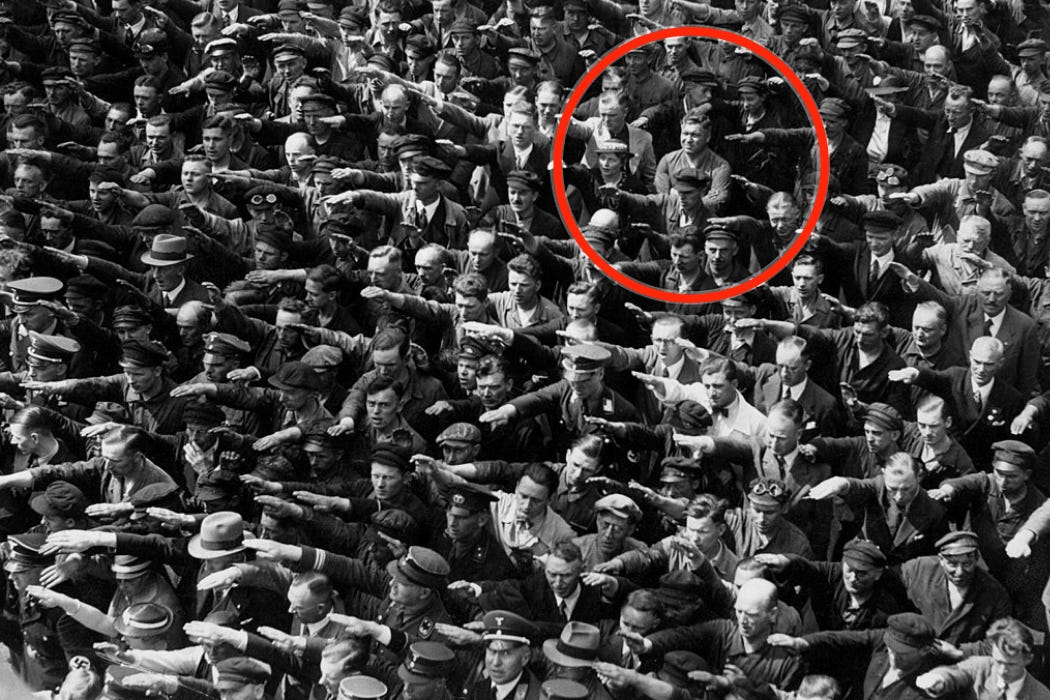
Related to this group of people, but in a different role, are those who, as Hannah Arendt stated, submit to authority in this context. Milgram’s experiment demonstrated that ordinary people are capable of inflicting serious harm on others simply out of obedience to a figure of authority perceived as legitimate, even when their actions contradict their own moral values. In a context of far-right strength, this phenomenon explains how citizens actively or passively collaborate in atrocities (harassment, assault, arrests, denunciations, deportations, executions…) without there being any intrinsic evil in the individuals. The key mechanism is the transfer of moral responsibility: the subject obeys because they perceive themselves as a mere “cog” that executes orders, as a “means”, while the authority figure (the leader, the party, the State) assumes ultimate responsibility for the consequences. Thus, the person executes whatever is necessary because the authority is responsible for what they do.
The second group to address is that group of people who facilitate the installation of far-right discourse or system, through processes of thoughtlessness that only serve to facilitate and reinforce that position. Carlo M. Cipolla attempted to answer this question in a brief satirical essay entitled “Allegro ma non troppo” (1988), in which he establishes the theory of human stupidity. In this, Cipolla proposes a formal theory of stupidity as a social force with its own, almost mathematical, laws, and establishes a matrix that classifies people according to two variables: the benefit they obtain for themselves and the harm/benefit they cause to others, thus classifying people into four types:
-
Intelligent: benefits themselves and benefits others.
-
Wicked: benefits themselves but causes harm to others.
-
Naïve: loses or causes harm to themselves but benefits others.
-
Stupid: causes harm to others and, in addition, ends up losing, causes harm to themselves, or obtains no benefit at all.
Thus, for Cipolla, the stupid person is one who harms another without obtaining any personal gain, and often even assuming costs and causing harm to themselves. Stupid people are a greater problem than wicked ones, because wicked people seek their own benefit regardless of the harm they cause to others, but their behavioural basis is rational (they analyse, they plan…). However, the basis of stupidity is not a lack of intelligence, but a totally and absolutely irrational behaviour, a behaviour, therefore, that violates the logic of self-interest and harm to others. According to Cipolla, intelligent people can defend themselves against wicked ones since their behaviour is logical and, therefore, predictable, but stupidity is based on irrationality and, consequently, is impossible to predict, so the best way to deal with it is to identify it in time and walk away, because trying to reason with it is useless.
This idea had already been addressed and established earlier by Dietrich Bonhoeffer. The German Lutheran theologian wrote about stupidity while he was a prisoner of the Nazis, shortly before being executed. Bonhoeffer also distinguishes between wickedness and stupidity. The wicked person acts with conscious intent to harm; therefore, they are guided by the patterns of logic and rationality, so, being predictable, they can be fought with reason and force. The stupid person, on the other hand, is much more dangerous because they are not aware of their own extreme irrationality. Stupidity, according to Bonhoeffer, is not innate, but an ethical and social defect: it arises when the person renounces exercising their critical judgement and uncritically submits to authorities, ideologies, collective slogans, or the masses themselves.
Following this same line, Bonhoeffer warns that, in the face of a totalitarian system, massive stupidity becomes a weapon of domination more effective than violence itself, because it makes victims collaborate in their own subjugation, convinced that they are acting correctly.