Genoa G8 2001: A Turning Point in the Anti-Globalization Movement
with No Comments

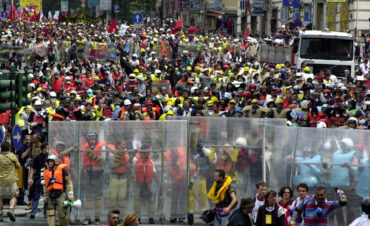
Between 19 and 22 July 2001, the Italian city of Genoa became the epicentre of the anti-globalization struggle. The meeting of G8 (Group of Eight) leaders triggered an unprecedented civic response, convened by the Genoa Social Forum, a platform that brought together around 800 organizations of different kinds. Estimates speak of between 200,000 and 300,000 people arriving from across Europe to take part in the counter-summit, at a time when the movement was at the height of its momentum. The … Read more

The Corporation: the documentary that diagnosed corporations with psychopathy
with No Comments

The Corporation (2003) is a Canadian documentary directed by Mark Achbar and Jennifer Abbott, with a screenplay by Joel Bakan, which examines the legal and ethical nature of large corporations. The film is structured around a provocative hypothesis: if corporations are considered legal persons, what kind of personality do they exhibit? Drawing on the criteria of the DSM-IV and the contributions of specialist Robert D. Hare, it argues that the structural behavior of the modern corporation aligns with traits characteristic … Read more

Coup, Reform, Rebellion, and Revolution: Key Concepts to Understand Political Change
with No Comments

Understanding the differences between these four concepts allows a more rigorous analysis of social and political processes. In political and media discourse, terms such as revolution, rebellion, reform, and coup d’état are often used imprecisely or interchangeably. Knowing their precise meaning allows people to form an informed opinion and interpret historical and contemporary events beyond ideological labels. Revolution is a profound and radical change in the political, social, and economic structures of a community, usually involving broad popular participation and … Read more

VPNs: Between Privacy and Covert Surveillance
with No Comments

Virtual Private Networks (VPNs) have become popular as tools to protect online identity and bypass censorship, and they are widely used by journalists and activists. However, protection is not automatic: it depends on the provider’s integrity and business model. Choosing a service requires evaluating its logging policy, jurisdiction, and monetization practices. Investigations, such as those conducted by Zimperium, have revealed that more than 65% of free mobile VPN applications contain vulnerabilities or collect data without consent, enabling its sale to … Read more

Resilience Against Learned Helplessness: Strategies for Transformative Activism
with No Comments

In social movements, a psychosocial phenomenon known as learned helplessness occurs when individuals or activist groups, after repeated exposure to repressive or invisibilizing situations, internalize the belief that they cannot change oppressive structures. This mechanism undermines individual and collective confidence, weakens the capacity for joint action, and facilitates political paralysis. A historical example of this dynamic is the Solidarity movement in Poland during the 1980s. Founded in the Gdańsk shipyards and led by Lech Wałęsa, it mobilized around 10 million … Read more

Technological Sovereignty: Free Tools vs. Corporate Domination
with No Comments

 Personal or institutional dependence on technological tools from corporations like Google and Microsoft constitutes a structural threat that goes beyond individual privacy. These companies operate through extractive models that commodify personal data, restrict interoperability, and create dependency through proprietary confinement or “vendor lock-in,” making it practically impossible to switch to another service provider. When using proprietary software, control over sensitive information is surrendered. Imposed updates modify functionalities without consent, algorithms manipulate behavior, and security breaches expose data to third parties. … Read more

Key Concepts. Violence, vandalism, terrorism, and non-violence.
with No Comments

The power structure has historically sought to associate protest and dissent with violence by using different concepts as synonyms, thus equating violence with dissent and non-violence with reformist processes. Five key concepts will therefore be distinguished below: Violence. Violence is understood as the deliberate use of physical or psychological force against individuals, groups or communities with the intention of causing harm. Galtung distinguishes between three levels: Direct violence. Explicit acts involving actions that cause physical or psychological harm to individuals … Read more

AMERICA: TRUTH, JUSTICE AND REPARATION
with No Comments

In recent years, the rejection by the Latin American population, especially indigenous people, of what “Hispanic Day” represents has grown steadily. This has manifested itself in many ways: demolition of statues, removal of street names, transformations of the October 12 celebration, etc. All this is motivated by the awareness of the horrors committed by such sinister characters as Christopher Columbus, Pizarro or Hernán Cortés, who committed crimes that today would be judged as against humanity1, as well as by indigenous … Read more

Fortress Europe: Migration policy in the EU
with No Comments

Everywhere in Europe racism creeps with increasing ease due to the voices of the xenophobic formations and the ultra-conservative stands. But also through a system of borders and policies that reveal an increasing institucionalization of said xenophobia. When in 2012 the European Commission launched a spot with xenophobic content that capitalized on the fear of others1 it received a lot of criticism. But was that spot an isolated event or a demonstration that the pillars of the European project are … Read more

CONTAINER RETURNS ARE BACK IN SPAIN
with 1 Comment

The draft of the Decree on Containers and Container Waste1 that the Spanish government is preparing could include a Deposit, Refund and Return System (DRS), which represents a great victory for one of the historic struggles for the ecologist movements in Spain. The DRS is a waste management model based on leaving a few cents in a deposit when a product is purchased with packaging and that are recovered when the empty packaging is returned. A report by the public … Read more

1 2 3 4 5 6 16